The global non-surgical skin tightening market continues to expand at a remarkable pace. According to IMARC Group, the market reached USD 1.5 billion in 2025 and is projected to reach USD 3.9 billion by 2034, representing a compound annual growth rate (CAGR) of 4.78%. Meanwhile, the Global Non-Surgical Skin Tightening Market was valued at USD 2.1 billion in 2024 and is expected to hit USD 4.5 billion by 2031, growing at an 11.30% CAGR.
As clinics expand their service menus, a critical investment decision emerges: should a practice acquire a Ultrasound HIFU Beauty Machine or integrate microneedle RF into its offerings? While both technologies are clinically validated non-invasive skin tightening modalities, they operate through fundamentally distinct mechanisms and target different layers of the skin.
HIFU (High-Intensity Focused Ultrasound) delivers focused acoustic energy to create thermal coagulation zones at depths reaching the SMAS layer. Microneedle RF combines physical micro-injury from fine needles with the delivery of radiofrequency thermal energy directly into the dermis, where collagen and elastin remodeling takes place.
This article provides aesthetic clinic owners and medical directors with an evidence-based comparison to determine which technology—or combination thereof—best aligns with their patient demographics, clinical capabilities, and return-on-investment objectives.
What is HIFU and How Does It Work?
High-Intensity Focused Ultrasound (HIFU) uses precisely focused acoustic energy to generate thermal coagulation zones at predetermined depths beneath the skin’s surface. Unlike lasers, which act superficially, or RF energy, which heats diffusely, HIFU delivers pinpoint focal zones as deep as 4.5 mm, reaching the Superficial Musculo-Aponeurotic System (SMAS)—the same structural layer manipulated in surgical facelifts.
The mechanism of action involves ultrasound waves converging at a focal point where temperatures of 60–70°C are generated. This induces immediate collagen denaturation and initiates a wound-healing cascade. Over 8 to 12 weeks, the body remodels collagen, resulting in tissue contraction, lifting, and improved dermal architecture.
A modern Ultrasound HIFU Beauty Machine typically offers multiple cartridge depths, commonly including 1.5 mm (superficial dermis), 3.0 mm (deep dermis), and 4.5 mm (SMAS layer), allowing practitioners to customize treatment based on patient age, skin condition, and specific concerns. Multi-depth capability extends to body applications for addressing areas such as the abdomen, thighs, and arms.
HIFU is FDA-cleared and CE-certified for non-invasive facial lifting. Clinical evidence supporting its efficacy includes a 2015 study in Lasers in Surgery and Medicine demonstrating statistically significant skin tightening with quantifiable SMAS contraction post-HIFU, and a 2020 trial in the Journal of Cosmetic Dermatology reporting patient satisfaction rates exceeding 90% after 1 to 2 sessions.
Ideal candidates for HIFU are patients presenting with mild-to-moderate facial laxity, specifically sagging along the jawline, submental fat (double chin), brow ptosis, and neck laxity. The treatment requires no needles and carries minimal downtime, though some patients experience transient discomfort due to deep focal heating. Visible results develop gradually over 3 to 6 months and typically last 12 to 18 months.
What is Microneedle RF and How Does It Work?
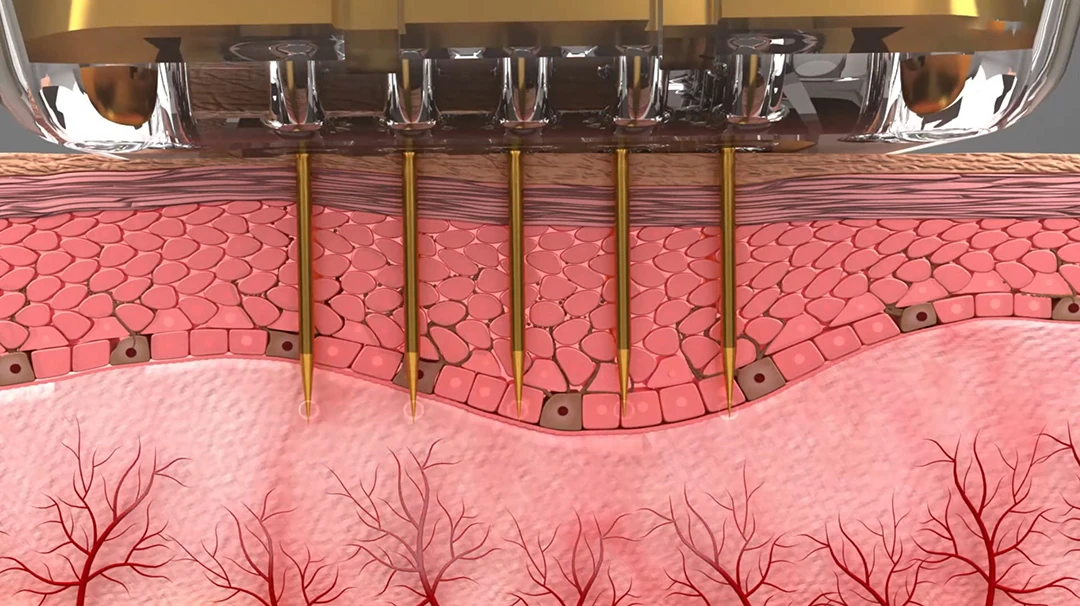
Radiofrequency microneedling (RFMN) works by combining two mechanisms simultaneously. Fine, insulated needles create controlled micro-punctures in the dermis, triggering the skin‘s natural wound-healing response. Simultaneously, radiofrequency energy is delivered through the needle tips to heat the surrounding tissue, stimulating fibroblast activity and collagen contraction. The thermal component causes immediate collagen contraction, while the micro-injury response drives ongoing neocollagenesis over weeks and months following treatment.
This dual-action mechanism enhances dermal remodeling in ways that mechanical microneedling alone cannot achieve. Histological analysis confirms increased collagen of up to 25% and elastin of 33.3% following RF microneedling treatment. Biopsy studies further demonstrate that RF microneedling increases dermal thickness by an average of 15–20% at three months post-treatment.
Treatment depth is adjustable. Published clinical literature recommends needle depths targeted to the reticular dermis, with optimal depths varying by facial region: forehead and temporal skin require at least 1.5 mm, the malar (cheek) region 1.0 mm, and the neck 1.5 mm. For skin tightening and laxity, thermal energy must reach the reticular dermis and surrounding connective tissue to trigger meaningful collagen contraction.
RF microneedling is a clinically-proven technology with a well-established safety profile across all Fitzpatrick skin types. Indications include fine lines and wrinkles, skin laxity (jawline, neck, under-eye area), skin texture irregularities, volume loss, and atrophic scars including acne scarring. It is particularly effective when the primary concerns extend beyond tightening alone—patients with enlarged pores, rough texture, acne scarring, or a history of photodamage benefit significantly from RF microneedling‘s remodeling effects.
Unlike HIFU, RF microneedling involves some post-treatment erythema and mild edema, typically resolving within 1 to 3 days. Topical anesthesia is required prior to treatment. Results are typically achieved through a series of 3 to 4 sessions spaced 4 to 6 weeks apart, with maintenance treatments recommended annually.
Head-to-Head Comparison: HIFU vs. Microneedle RF
The table below summarizes key clinical and operational differences between HIFU and microneedle RF, enabling clinic decision-makers to evaluate each modality against their practice‘s specific needs.
| Comparison Dimension | HIFU (Ultrasound HIFU Beauty Machine) | Microneedle RF |
| Core Mechanism | Focused ultrasound (acoustic energy) delivering pinpoint thermal coagulation | Mechanical micro-needling + RF thermal energy delivered through needle tips |
| Maximum Penetration Depth | SMAS layer at 4.5 mm (plus 1.5 mm and 3.0 mm options) | Reticular dermis, typically 0.5 mm to 3.5 mm (adjustable) |
| Primary Indications | Facial contour sagging, jawline laxity, submental fat, brow elevation, neck tightening | Skin laxity (mild-to-moderate), enlarged pores, acne scarring, fine lines, texture irregularities, eye area rejuvenation |
| Epidermal Impact & Downtime | No epidermal injury; minimal to zero visible downtime | Micro-injury present; 1–3 days of erythema and mild edema |
| Number of Sessions Required | 1–2 sessions for significant lifting effect (maintain annually) | Series of 3–4 sessions for optimal results (maintain 6–12 months) |
| Result Onset & Duration | Gradual onset over 3–6 months; duration typically 12–18 months | Progressive improvement over 3–4 months; maintenance needed |
| Need for Numbing/Topical Anesthesia | Usually not required (some patients may prefer) | Required for patient comfort |
| Suitability by Fitzpatrick Skin Type | All skin types (non-melanin-dependent) | All skin types (safe across Fitzpatrick I–VI) |
The Critical Role of Pre-Treatment Diagnostics in Clinics
Accurate patient selection is arguably more important than technology choice. Before recommending either HIFU or microneedle RF, objective skin assessment using diagnostic imaging technology is essential.
A professional skin analyzer machine enables clinics to quantify key parameters that directly inform treatment planning, including collagen density, skin elasticity scores, pore characteristics, pigmentation patterns, and UV damage. These systems employ multi-spectral imaging to capture high-resolution skin photographs, revealing subsurface conditions that are not visible to the naked eye.
For a clinic evaluating a new capital equipment purchase, partnering with a reputable Skin Analyzer Manufacturer offers several strategic advantages. High-precision imaging algorithms, consistent calibration standards, and customizable reporting systems allow clinics to establish objective baseline measurements for every patient. Furthermore, before-and-after comparisons generated by these systems provide verifiable evidence of clinical outcomes, supporting both patient conversion and marketing claims.
Diagnostic imaging also helps clinics identify patients who may benefit more from one technology over the other. A patient with Grade 3–4 skin laxity on the diagnostic scoring scale—characterized by significant SMAS descent—may achieve superior lifting results with HIFU. Conversely, a patient with low collagen scores but prominent textural irregularities and scarring is more likely to respond optimally to a course of RF microneedling treatments.
Complementary Treatments for Comprehensive Rejuvenation
For clinics seeking to maximize patient outcomes and treatment revenue per visit, strategic combination therapy protocols offer considerable advantages. Neither HIFU nor microneedle RF alone addresses every dimension of facial aging.
For patients presenting with advanced photodamage, significant dyspigmentation, or deep static rhytids, the addition of Fractional CO2 Laser Skin Resurfacing to the treatment plan can achieve results unattainable by either ultrasound or RF technologies alone. Fractional ablative CO2 lasers generate thousands of micro-ablative zones and micro-thermal zones of injury, stimulating collagen remodeling while preserving untreated skin bridges that accelerate healing. This modality effectively treats sun damage, stubborn pigmentation, acne scars, rough texture, enlarged pores, fine lines, and skin laxity on the face.
Similarly, CO2 laser tightening skin benefits are well-documented. Sequential application of fractional CO2 followed by non-ablative wavelengths expands the thermal coagulation zone surrounding each ablation column, enhancing tissue tightening and neocollagenesis compared to CO2 monotherapy. Many top-tier clinics now incorporate HIFU followed by fractional RF microneedling to address multiple skin layers in a single comprehensive rejuvenation protocol.
When designing combination protocols, clinicians should consider treatment intervals. HIFU and microneedle RF can be combined in staged plans, with HIFU addressing the deep structural foundation and RF microneedling improving surface quality. However, treatments should be separated appropriately—typically 4 to 8 weeks apart—to avoid excessive thermal load on tissue.
Strategic Buying Guide for Aesthetic Clinics
For clinics planning a capital equipment acquisition, the decision between an Ultrasound HIFU Beauty Machine and an RF microneedling system should be informed by several key factors.
- Budget and ROI Considerations: Capital costs for professional-grade HIFU devices typically range from USD 12,000 to USD 30,000, while RF microneedling systems occupy a similar price bracket. However, ongoing operational expenses differ. HIFU has per-patient consumable costs tied to the number of shot counts (energy pulses) delivered per session. RF microneedling involves single-use sterile needle cartridges that must be replaced after each patient. Pricing strategies also differ: HIFU treatments are typically positioned as higher-ticket single sessions (USD 800–2,500 per full-face treatment), while RF microneedling generates recurring revenue through multi-session packages.
- Client Demographics and Overlap Analysis: Clinics serving a mature patient population (ages 45+) concerned primarily with facial ptosis, jowling, and loss of contour definition will find that HIFU aligns well with these clinical demands. Patients with needle aversion—a common barrier to treatment acceptance—also favor the needle-free experience of HIFU. Conversely, clinics treating a younger patient demographic (ages 30–45) concerned with skin texture, pore refinement, acne scarring, and early laxity will achieve stronger patient satisfaction with RF microneedling. For clinics serving both segments, acquiring both technologies as complementary services—rather than direct replacements—often represents the optimal long-term strategy.
FAQs
Q1: Can HIFU and microneedle RF be performed in the same treatment session?
A: Yes, but with appropriate interval spacing. While the two technologies target different tissue depths (HIFU reaching the SMAS at 4.5 mm versus RF microneedling acting within the reticular dermis at 1.0–3.5 mm), simultaneous application may create excessive thermal load on tissue. Most clinical protocols recommend separating the treatments by 4 to 8 weeks, allowing the full wound-healing cascade from the initial modality to complete before introducing the second. Treatment order should be determined by a qualified medical professional based on patient-specific factors.
Q2: Which device should a clinic purchase first—HIFU or microneedle RF?
A: The answer depends on your clinic‘s existing patient base and service gaps. Conduct a simple patient needs assessment: what proportion of your consultations involve complaints about sagging/contour loss versus texture/pores/scarring? If deep lifting and contouring comprise the majority of patient requests, acquire an Ultrasound HIFU Beauty Machine first. If skin texture refinement, acne scar treatment, and general skin quality improvement dominate your consultations, prioritize an RF microneedling system. Clinics with sufficient capital and patient volume often proceed to acquire both technologies within 12 to 18 months to offer comprehensive facial rejuvenation protocols.
Conclusion
HIFU and microneedle RF represent two distinct but complementary approaches to non-surgical skin tightening. HIFU, delivered through a HIFU beauty machine, provides deep structural lifting by targeting the SMAS layer, making it the preferred choice for patients concerned primarily with facial ptosis and contour loss. RF microneedling offers superior results for skin texture, pore refinement, acne scarring, and mild-to-moderate laxity through a combined mechanical-thermal mechanism that induces substantial dermal remodeling.
For clinics committed to evidence-based practice, objective diagnostic assessment using a professional skin analyzer machine with advanced imaging algorithms—is essential to guide technology selection and validate outcomes . Furthermore, incorporating CO2 laser tightening skin into comprehensive treatment protocols addresses aspects of facial aging that neither ultrasound nor RF technologies alone can fully resolve.
The optimal technology portfolio for any clinic will reflect its unique patient demographics, clinical expertise, and business objectives. By understanding the strengths and limitations of each modality and implementing appropriate diagnostic and complementary treatment pathways, clinics can deliver superior patient outcomes while building sustainable, profitable service lines.