Introduction
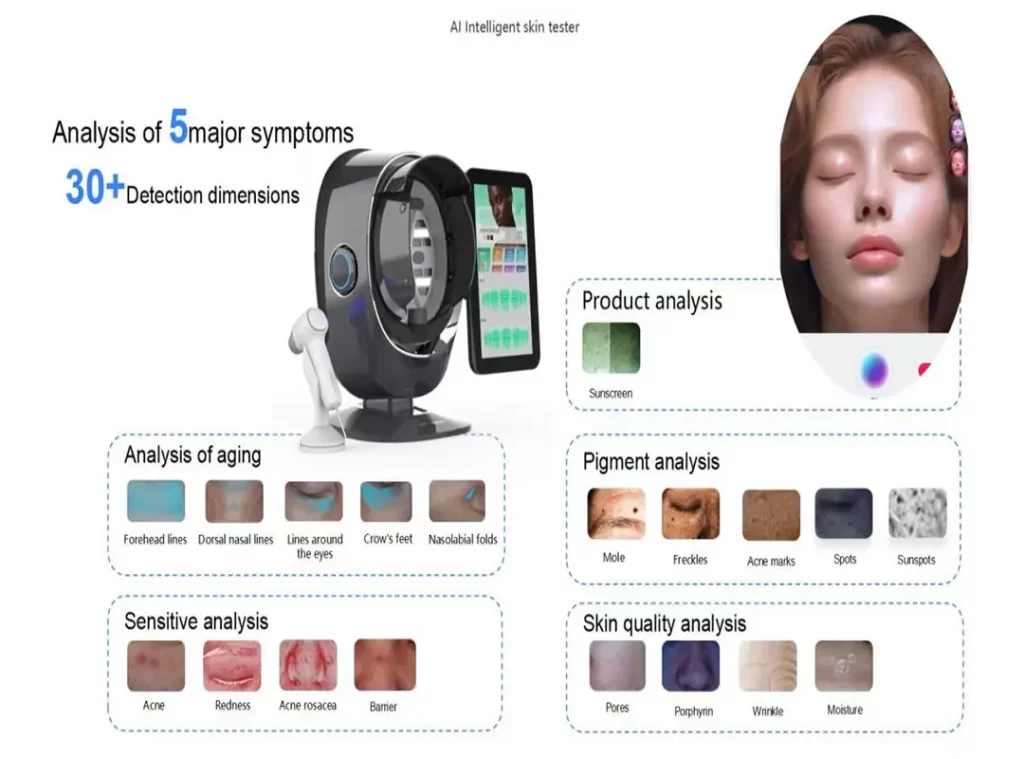
The first consultation often determines whether a patient decides to proceed with treatment. While many people seek professional advice, they also want clear reasons behind every recommendation. When assessments rely only on visual observation and clinical experience, explaining hidden skin concerns can sometimes be difficult, leaving patients uncertain about the need for treatment. AI-powered skin imaging analyzers help make consultations more objective. Using multi-spectrum imaging and automated analysis, these systems reveal concerns such as UV damage, pigmentation, wrinkles, and skin texture that may not be visible to the naked eye. The visual reports make it easier for practitioners to explain findings and help patients better understand their skin condition.
For aesthetic clinics, this creates a more transparent consultation process. When recommendations are supported by measurable skin data, patients are often more confident in making treatment decisions. In this article, we’ll explain how to interpret AI skin imaging reports and use the results to communicate treatment options more effectively, including picosecond laser and fractional CO₂ laser procedures.
The Psychology of “Visual Proof” in Aesthetic Consultations
The biggest obstacle to converting high-ticket laser treatments is not the price; it is the client’s internal disbelief about the severity of their condition. Human psychology dictates that without visual evidence of a problem, the perceived need for a solution remains low. A client might notice a faint spot or slightly enlarged pores, but they often dismiss these as minor cosmetic issues unworthy of a laser procedure.
This is where an advanced skin analysis machine becomes indispensable. Using modalities like cross-polarized light and UV fluorescence, modern analyzers—such as the HOMI HM-S5 or HM-K33—reveal the invisible truth beneath the skin’s surface. The report displays a high-resolution map of transepidermal water loss, deep dermal melanin concentrations, and collagen breakdown in the papillary dermis that are completely undetectable to the human eye. When a 35-year-old client sees a UV image showing a sea of speckled, subclinical sun damage covering her apparently “clear” complexion, her perception shifts instantly. The treatment is no longer a luxury sale; it becomes a necessary intervention to prevent future visible aging. This visual reveal effectively taps into loss aversion, making the client proactive about their skin’s future.
Consequently, the practitioner’s role is elevated. You are no longer perceived as a salesperson pushing a commission-based agenda. Instead, by systematically interpreting objective, clinical data, you establish expert authority and position yourself as a genuine “skin health manager.” This diagnostic-first approach builds trust, the most critical currency in aesthetic medicine.
Translating Diagnostic Reports into Laser Bookings
A sophisticated report provides a wealth of data, but its true commercial value is realized only when consultants can seamlessly connect a specific data point to a specific therapeutic technology. Below is a structural framework for mapping common report indicators to targeted laser modalities. The table below sets out the correspondence between AI report metrics and treatment plans.
| AI Report Indicator | Imaging Modality | Client Concern | Recommended Laser Solution | Proposed Mechanism & Benefit |
| Deep Spots & UV Damage | UV/Parallel Polarization | “Invisible” sun damage, potential future hyperpigmentation | Picosecond Laser | Photoacoustic disruption of melanin before it surfaces; preemptive clearing. |
| Texture & Wrinkle Depth | 3D Reconstruction | Rough surface, fine lines, dermal atrophy | Fractional CO2 Laser | Micro-ablative columns stimulate neo-collagenesis for comprehensive resurfacing and tightening. |
| Enlarged Pores & Acne Scars | Texture/Roughness Analysis | Loss of structural support, boxcar/rolling scars | Fractional CO2 Laser | Deep dermal remodeling to rebuild the structural lattice and smooth scar edges. |
Deep Spots & UV Damage ➔ Upselling Picosecond Laser
A standard visible-light image might show a clean, fair complexion. However, the UV filter on a high-precision analyzer reveals the stark reality of actinic damage: dense clusters of melanin accumulating deep in the basal layer. These represent epidermal pigmentation factories that will migrate to the skin’s surface within 12 to 24 months.
The logic linkage here is prevention. You can explain to the client that conventional topical serums or microdermabrasion cannot penetrate to this depth to dismantle these melanin reservoirs. Here, the consultant might state:
“Using the HM-S5’s UV imaging, you can clearly see that although your surface skin is currently even-toned, a significant amount of melanin has accumulated in the basal layer. Gentle skincare can’t effectively address pigment at this depth. To prevent these patches from appearing over the next few years, we recommend a non-invasive solution like the PICOACE Picosecond Laser . Its ultra-short pulses generate a strong photoacoustic effect to precisely shatter these hidden pigment particles into dust, allowing your body to eliminate them naturally before they ever become a visible problem.”
Texture, Pores & Wrinkle Depth ➔ Upselling Fractional CO2 Laser
The 3D texture reconstruction feature of an AI analyzer provides a micrometric topography of the skin’s surface, quantifying the depth of wrinkles and the volume loss of atrophic scars. A report showing elevated roughness indices and deep pore scores indicates a breakdown in the dermal extracellular matrix.
The clinical bridging point is that a compromised dermal scaffold cannot be rebuilt by merely hydrating the stratum corneum. True structural repair requires a controlled injury to kickstart the healing cascade. A practical dialogue formula could be:
“Your report indicates that the roughness index in your cheek area is elevated, and the pore depth extends into the superficial dermis. This isn’t just dehydration; it’s a sign that the underlying collagen support has weakened. To effectively reconstruct this supportive meshwork, we recommend the FraxRe 10600nm *Fractional Co2 Laser**. This technology creates microscopic treatment zones that safely ablate damaged tissue while leaving surrounding skin intact. This thermal effect signals fibroblasts to produce new collagen and elastin, naturally smoothing acne scars, refining pore size, and restoring firmer texture from the inside out.”*
A 4-Step Clinical Workflow to Improve Conversion Rates
Implementing a structured, data-driven workflow ensures consistency across all consultations and maximizes the conversion potential of every patient journey.
Step 1: The 5-Minute Pre-Consultation Scan
Before any conversation about concerns or history, have the client undergo a multi-spectral capture with the skin analysis machine. This eliminates waiting anxiety and ensures the subsequent consultation is based entirely on objective data, not just the client’s self-reported issues.
Step 2: The “Current vs. Future” Comparison
Focus the initial report review on comparative aging simulation. Highlight the UV damage forecast alongside the current inflammatory status (redness areas). This frames the discussion around risk management and future deterioration, not just immediate aesthetics, increasing the urgency for therapeutic intervention.
Step 3: Diagnostic-Driven Treatment Plans
Translate the report’s quantitative indices directly into written treatment goals. For instance, document a goal to reduce the deep spot index from 68 to 35 over a series of three Picosecond Laser sessions. Similarly, for textural concerns, you might set a target improvement score to be achieved with a full course of fractional CO2 laser treatments. This specificity communicates a medically rigorous, outcome-oriented plan rather than a generic spa menu.
Step 4: Post-Treatment Proof and Retention
Perform a follow-up scan after the designated treatment course to capture clearances in deep pigmentation and improvements in 3D texture. Displaying a side-by-side comparison of the multi-spectral data provides tangible proof of efficacy. This objective evidence not only validates the client’s investment but also forms the unshakable basis for planning the next phase of maintenance and rejuvenation, driving long-term retention.
Why Hardware Precision Matters – Selecting the Right Manufacturing Partner
The clinical credibility of your entire data-driven workflow hinges on the accuracy of the diagnostic input. A low-quality imaging device that produces blurry, color-inaccurate, or algorithmically distorted reports does more harm than good. It can misdiagnose melasma as simple PIH, miss early actinic damage entirely, and ultimately erode the trust you have worked hard to build.
Therefore, choosing a reliable Skin Analyzer machine Manufacturer is a foundational business decision. A partner like HOMI Beauty, which specializes in both diagnostic and therapeutic light-based technologies, brings significant advantages. Their experience in manufacturing high-fidelity analyzers like the HM-S5, featuring multiple light sources and robust AI algorithms, ensures that the data you present to clients is clinically meaningful, repeatable, and trustworthy.
Furthermore, sourcing both diagnostics and treatment devices from a single, integrated manufacturer creates a seamless clinical ecosystem. For a clinic, this means the aesthetic analyzer capturing the pathology and the lasers treating it—specifically the PICOACE for pigment and a Fractional Co2 Laser like the FraxRe for texture—are supported by a unified technical and service infrastructure. This simplifies staff training, streamlines maintenance protocols, and reduces the complexity of vendor management. The objective is not just to own a machine, but to implement a clinically synchronized, end-to-end solution for photo diagnostics and laser therapy.
Conclusion
The aesthetic industry is moving irreversibly toward objective, data-driven, and evidence-based practice. In an era where clients are more informed and more skeptical than ever, the clinic that can present a crystalline, visual, and scientifically grounded narrative will win both the immediate booking and the long-term loyalty. A skin analysis machine is no longer a novelty; it is the central nervous system of a modern laser practice.
By committing to a diagnostic-first philosophy and integrating that philosophy with precise, condition-specific technologies like Picosecond Laser, clinic operators can achieve a dual objective: growing treatment bookings not through high-pressure sales, but through genuine, patient-centered education. With the right tools and a systematic workflow, doubling your laser bookings is not an act of marketing hyperbole—it is the organic result of building trust through irrefutable visual proof.
FAQ
Q1: How does a skin analysis machine work to detect damage I cannot see?
A: It uses multiple light spectra, including cross-polarized and UV light, to capture images at different skin depths. AI algorithms then analyze these images to identify and quantify subsurface conditions like deep pigmentation, vascular lesions, and collagen structure, which are invisible under normal light.
Q2: Is it safe to use a Picosecond Laser on darker skin types?
A: Modern Picosecond Laser technology, with its ultra-short pulse duration and a primarily photoacoustic rather than photothermal effect, offers a safer profile for treating pigmentation in darker skin types compared to older nanosecond Q-switched lasers. However, appropriate settings and a test spot are always mandatory.
Q3: How long is the downtime after a Fractional Co2 Laser procedure?
A: This depends on the treatment density and energy. A light, non-ablative fractional resurfacing session may result in only 1-2 days of redness. A more aggressive, ablative Fractional Co2 Laser treatment for deeper scars or wrinkles typically entails 5-7 days of social downtime, during which the skin will appear red and develop a sandpaper-like micro-crust as it heals.
Q4: Why is it important to buy from an experienced Skin Analyzer machine Manufacturer?
A: For established manufacturers of skin analysis devices, both excellent hardware calibration—covering camera sensors and lighting systems—and clinically validated, advanced AI algorithms are indispensable. Only in this way can the accuracy and reliability of diagnostic interpretations be ensured, thereby strengthening patients’ trust in the healthcare team. In contrast, devices of mediocre quality often produce inconsistent results, which not only make it difficult for clinicians to rely on them but may also inadvertently mislead clinical judgements.