When selecting an aesthetic laser system for a medspa, pulse width is one of the key specifications that directly affects treatment performance, recovery time, and patient safety. The length of each pulse determines how laser energy interacts with pigment. A shorter pulse creates stronger mechanical effects, while a longer pulse produces more heat. This difference can influence downtime, PIH risk, and whether the device is suitable for different skin types. For clinics, the advertised pulse width is only part of the story. What matters more is whether the device can maintain stable output during real treatments, since inconsistent pulses may lead to unpredictable results and unnecessary safety concerns.
1. Understanding Pulse Width: The Physics of Ultra-Short Pulse Technology
Pulse width refers to how long a laser pulse lasts. In picosecond systems, this duration is measured in trillionths of a second and determines how quickly energy is delivered to the pigment target. Traditional Q-switched nanosecond lasers deliver energy over a longer period of time. Because of this longer exposure, their main working mechanism is based on heat generation rather than purely mechanical disruption. Although this technology has been widely used for decades, the additional heat generated during treatment may affect nearby tissues and increase recovery concerns, especially for patients with darker skin tones.
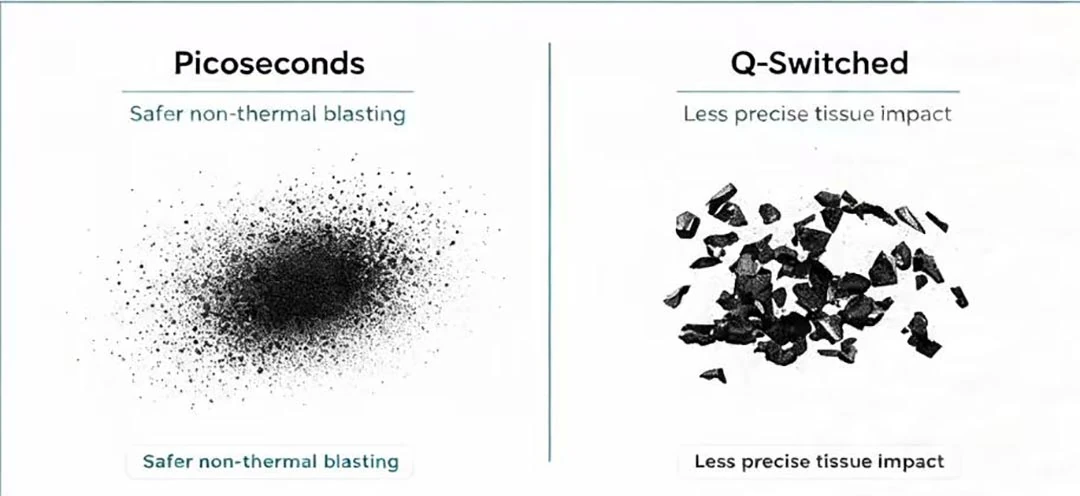
A picosecond laser device operates differently by shortening the energy delivery time and increasing the contribution of photoacoustic effects. When a pulse lasts only a few hundred picoseconds, the dominant mechanism shifts from photothermal to photoacoustic. Instead of relying mainly on heat accumulation, ultra-short pulses create stronger mechanical stress that breaks pigment particles into smaller fragments. These micro-particles are then cleared by the lymphatic system with minimal collateral heating of the dermis.
By reducing heat accumulation in surrounding tissue, picosecond technology has become increasingly popular among clinicians treating pigmentation issues in Fitzpatrick IV–VI skin types. A 450ps pulse confines energy so tightly that melanosomes exceed their mechanical stress threshold before thermal relaxation can occur. A slightly longer 750ps pulse remains within the picosecond range but introduces a modest thermal component, which some clinicians prefer when stimulating dermal remodeling. Understanding these differences helps buyers compare laser platforms based on actual technical performance rather than only marketing specifications.
2. Comparing Pulse Widths: 450ps vs. 750ps vs. Nanosecond Systems
Different laser platforms use different pulse durations, and these differences can affect how the device performs in actual clinical applications. The table below presents a structured comparison to clarify how the treatment mechanism evolves as pulse width shortens.
| Parameter | Q-Switched Nanosecond | Long-Pulse Picosecond (e.g., 750ps) | Ultra-Short Picosecond (e.g., 450ps) |
| Primary Action | Photothermal (heat) | Mixed (thermal & acoustic) | Strong photoacoustic (mechanical shattering) |
| Target Particle Size | Cobblestone-like | Pebble-like | Dust-like particles (easily cleared) |
| Thermal Risk | Moderate | Low | Minimal (safe for Fitzpatrick IV-VI) |
| Best Suited For | Standard dark tattoos | Multi-color tattoos, mild rejuvenation | Stubborn ink, melasma, skin rejuvenation |
| Typical Downtime | 3–7 days with pinpoint bleeding | 1–3 days, mild erythema | 0–1 day, transient erythema |
When a practice intends to treat resistant blue or green tattoo inks, or to manage melasma in Asian and Hispanic populations, a picosecond laser device in the 450ps range delivers a compelling balance of power and safety. Systems operating around 750ps can still provide excellent clinical results and may offer a wider thermal signature for collagen stimulation during whole-face treatments. What matters most is that the platform reliably maintains its stated pulse width at all energy levels—a detail often missing from specification sheets.
3. Clinic Considerations: Matching Pulse Width to Your Target Treatments
- Tattoo Removal: Multi-colored professional tattoos contain ink particles of varying sizes. Dark, carbon-based pigments respond well to nanosecond pulses, but lighter shades—especially sky blues, greens, and yellows—require the mechanical disruption that only a short-pulse system can provide. With a pulse width around 450ps, picosecond laser machines can break pigment into smaller fragments. In some cases, this may help improve clearance of difficult colors and reduce the number of sessions needed. For a tattoo-focused clinic, having both 1064nm and 532nm wavelengths with true picosecond duration is critical.
- Epidermal and Dermal Pigmentation: Melasma is considered one of the more difficult pigmentation conditions to treat because excessive heat may worsen pigmentation in some patients. The photoacoustic advantage of a sub-500ps pulse makes it possible to destroy melanin-rich keratinocytes without overheating the basal layer, significantly reducing PIH risk in Fitzpatrick type IV–VI patients. Freckles, age spots, and nevus of Ota also respond favorably, with many patients seeing visible clearing after a single session.
- Skin Rejuvenation: When a fractional lens array is attached to a picosecond platform, a portion of the acoustic energy creates laser-induced optical breakdown (LIOB) micro-cavities within the dermis. These controlled injury zones stimulate neocollagenesis and elastin remodeling without damaging the epidermis. A picosecond laser device equipped with interchangeable handpieces therefore functions as a non-thermal rejuvenation workstation, addressing fine lines, enlarged pores, and acne scars on the same console used for pigment clearance.
HOMI Beauty’s PICOACE Nd:YAG platform combines multiple treatment functions within one system, including tattoo removal, pigmentation treatment, and fractional rejuvenation. It delivers dual wavelengths (1064nm and 532nm) with an optional 755nm applicator, maintaining stable sub-500ps pulse widths through an articulated arm delivery system. This design lets a single console cover tattoo removal, pigmentation disorders, and fractional skin revitalization, reducing the equipment footprint while expanding the service menu. Built-in diagnostics monitor pulse-width stability, an important feature for clinics that rely on reproducible outcomes across high-volume treatment schedules.
4. ROI and Sourcing: Navigating System Pricing
Several legitimate factors shape the picosecond laser machine price you will encounter during sourcing. The quality of the Nd:YAG crystal and the electro-optical modulation system determine whether every pulse stays within the specified picosecond domain. Articulated arm delivery optics preserve beam quality better than fiber-coupled alternatives but are costlier to manufacture and align. Additionally, some consoles can only maintain a true picosecond pulse at maximum energy; at lower fluences used for melasma, the pulse may broaden and lose efficacy.
When comparing low-cost picosecond laser systems, buyers should carefully verify pulse specifications, because actual output performance can vary significantly between manufacturers. Such devices fail to deliver the promised clinical results and can generate excessive heat, leading to burns, scarring, and medico-legal complications. Evaluating total cost of ownership—including consumables, warranty coverage, downtime, and reputational risk—reveals that a mid-tier OEM factory-direct price from a verified manufacturer frequently offers the strongest return on investment.
5. How to Select a Reliable Manufacturer of Aesthetic Laser Platforms
When selecting a picosecond laser machine manufacturer, clinics should consider several practical factors, including certification, production quality, technical support, and after-sales service. First, verify international certifications such as CE marking under the Medical Device Regulation, which requires third-party validation of safety and performance claims including pulse width accuracy. Second, investigate the manufacturer’s optical assembly environment and quality control protocols—consistent output from unit to unit is the hallmark of a company that controls its supply chain. Third, confirm that hands-on clinical training, multilingual technical support, and clear service-level agreements are included in the purchase terms.
Finally, transparent pricing and warranty terms protect your investment. Sourcing directly from an established picosecond laser machine manufacturer eliminates distributor markups while maintaining warranty integrity. HOMI Beauty applies these principles as a long-standing developer of aesthetic platforms. The PICOACE system is assembled in an ISO-compliant facility, undergoes rigorous optical alignment before shipment, and is supported by factory-direct pricing, one-on-one clinical training, and dedicated after-sales service. A 2021 review in Lasers in Surgery and Medicine noted that picosecond lasers with a pulse duration below 500ps are associated with significantly lower PIH incidence in darker skin types when compared to nanosecond alternatives—a clinical reality that underscores the importance of partnering with a manufacturer that delivers genuine pulse width performance.
Frequently Asked Questions
Q1: What is the main difference between nanosecond and a picosecond laser device?
A1: The primary difference lies in the pulse duration and the resulting tissue interaction. A nanosecond laser works through a photothermal effect, heating and shattering pigment particles, whereas a picosecond laser device relies on a photoacoustic effect, using shockwaves to crumble pigment into micro-particles with minimal thermal damage to the surrounding skin.
Q2: What is a reasonable picosecond laser machine price for a clinical-grade platform?
A2: The picosecond laser machine price varies considerably based on the laser source, delivery system, and manufacturer. Professional-grade platforms with articulated arm delivery and stable pulse-width output range from mid-tier OEM factory-direct prices to higher brand-premium levels. Sourcing directly from a verified manufacturer helps medspas avoid unnecessary markups while securing comprehensive warranties.
Q3: How does the PICOACE system protect patient safety across different skin types?
A3: The PICOACE platform leverages ultra-short pulse widths to minimize collateral thermal diffusion. This approach significantly reduces the risk of post-inflammatory hyperpigmentation, making the system a safer option for darker skin tones on the Fitzpatrick scale (types IV–VI) when compared with traditional nanosecond technologies.
Conclusion
Pulse width is one of the most important factors when choosing a picosecond laser machine because it affects treatment results, patient comfort, and the range of applications a clinic can offer. A true picosecond pulse, particularly in the sub-500ps range, broadens your clinical indications from stubborn tattoos to melasma and full-face rejuvenation while keeping PIH risks low for a diverse patient base. Balancing the system cost with device authenticity and manufacturer support turns this capital investment into predictable revenue and a durable clinical reputation. To examine the PICOACE platform and its pulse-width capabilities in further detail, visit the HOMI Beauty website or contact their team for a customized configuration and quotation tailored to your medspa’s requirements.