Introduction
The effectiveness of a tattoo removal or pigmentation treatment system depends greatly on the wavelength it delivers. While many laser platforms appear similar on the market, the choice between 1064nm and 532nm wavelengths directly determines which pigments can be effectively targeted and how versatile the system can be in clinical applications.
This is why dual-wavelength Q-Switched Nd Yag Laser systems have become a preferred option for many aesthetic clinics and distributors. By combining 1064nm and 532nm wavelengths, one platform can address different pigment depths and colors—from deep black tattoo inks to superficial pigmentation concerns.
For buyers evaluating laser equipment, understanding the role of each wavelength is essential. It helps determine whether a system can support diverse treatment needs, improve equipment utilization, and deliver long-term investment value.
Understanding How Q-Switched Nd:YAG Laser Technology Targets Pigments
A Q-Switched Nd Yag Laser works by releasing laser energy in extremely short nanosecond pulses. This allows the system to generate high peak power while limiting unnecessary heat diffusion into surrounding tissues.
When laser energy is absorbed by pigment particles, it creates a photoacoustic effect that causes the pigment to fragment into smaller particles. These fragments can then be gradually processed by the body’s natural mechanisms.
The effectiveness of treatment depends on several factors, including wavelength, pulse duration, energy density, spot size, and pigment characteristics. Among these factors, wavelength selection plays a key role because different wavelengths interact with pigments at different depths.
The Photoacoustic Effect Behind Pigment Fragmentation
The main principle behind Q-switched laser treatment is selective pigment targeting. Because the pulse duration is extremely short, pigment particles absorb concentrated energy before significant thermal damage spreads to surrounding areas.
For tattoo removal, this mechanism allows laser energy to interact with tattoo ink particles rather than broadly heating the skin. Different tattoo colors absorb different wavelengths, which is why professional systems often provide multiple wavelength options.
For pigmentation treatments, the same principle applies. The laser wavelength needs to match the characteristics of the target pigment to achieve efficient energy absorption.
Why Wavelength Selection Determines Treatment Depth
Laser wavelength affects how deeply light can penetrate into the skin and how strongly it is absorbed by different pigments.
Generally, shorter wavelengths have stronger absorption by superficial pigments, while longer wavelengths can penetrate deeper into tissue.
This difference explains why dual-wavelength systems are widely used in aesthetic applications. By combining 1064nm and 532nm, a single platform can address both deeper and more superficial pigment conditions.
1064nm vs. 532nm: How Dual-Wavelength Systems Treat Different Pigments
The primary advantage of a dual-wavelength Q-Switched Nd:YAG system is flexibility. Instead of using one wavelength for all treatments, practitioners can select the wavelength based on pigment depth and color.
| Comparison Factor | 1064nm Q-Switched Nd:YAG Laser | 532nm Q-Switched Nd:YAG Laser |
| Wavelength range | Near-infrared | Visible green light |
| Penetration depth | Deeper penetration | More superficial penetration |
| Common applications | Dark tattoo ink, deeper pigmentation | Epidermal pigmentation, selected colored tattoo inks |
| Typical pigment targets | Black and blue pigments | Red, orange, and warm-colored pigments |
| Main consideration | Suitable for deeper targets | Requires careful parameter adjustment due to higher melanin absorption |
1064nm Q-Switched Nd:YAG Laser for Deep Pigment and Dark Tattoo Removal
The 1064nm wavelength is the fundamental wavelength of Nd:YAG laser technology and is one of the most widely used configurations for pigment treatments.
Due to its deeper penetration and lower absorption by epidermal melanin compared with shorter wavelengths, 1064nm is commonly used for darker tattoo pigments and deeper pigment targets.
For Q Switched Nd Yag Laser Tattoo Removal, the 1064nm wavelength is often selected for black and dark blue tattoo inks because these pigments can effectively absorb this wavelength.
It is also commonly associated with deeper pigmentation applications, where reaching pigment located further below the skin surface is important.
However, treatment parameters must always be adjusted according to individual conditions, including pigment type, skin characteristics, and treatment area.
532nm Q-Switched Nd:YAG Laser for Epidermal Pigmentation and Colored Tattoo Removal
The 532nm wavelength has a shorter penetration depth and stronger absorption characteristics for certain superficial pigments.
Because of these properties, it is commonly used for epidermal pigmentation concerns and selected tattoo colors, especially warmer shades such as red and orange.
For Nd Yag Laser Pigmentation Removal, 532nm can be considered when treating superficial pigment conditions where higher absorption is beneficial.
However, because 532nm is more strongly absorbed by melanin, practitioners need to carefully select treatment parameters according to skin type and pigment characteristics.
A dual-wavelength system provides greater flexibility by allowing clinics to choose between 1064nm and 532nm depending on the treatment objective.
Beyond 1064nm and 532nm: Additional Applications of Q-Switched Nd:YAG Laser Systems
Although tattoo removal and pigmentation treatment are the most common applications of Q-switched Nd:YAG technology, many clinics also use these systems for additional aesthetic procedures.
A versatile laser platform allows clinics to expand their service portfolio while using the same equipment for different treatment categories. However, treatment selection should always be based on professional assessment, patient conditions, and appropriate treatment parameters.
Carbon Peeling and Skin Rejuvenation Applications
In addition to pigment removal, Q-switched Nd:YAG laser systems are also widely associated with carbon peel treatments.
During carbon peeling, a carbon-based lotion is applied to the skin surface before laser energy is delivered. The laser interacts with the carbon particles, creating a non-ablative treatment approach commonly used in aesthetic skin care procedures.
This application demonstrates the flexibility of Q-switched Nd:YAG technology beyond traditional tattoo removal. For clinics, a multi-functional laser platform can help improve equipment utilization by supporting different treatment services.
Expanding Treatment Options for Modern Aesthetic Clinics
Modern aesthetic clinics often look for equipment that can support multiple applications rather than a single procedure.
A dual-wavelength Q-Switched Nd Yag Laser system can support treatments related to:
- Tattoo pigment removal
- Pigmentation management
- Carbon peel applications
The ability to switch between wavelengths provides practitioners with more options when treating different pigment conditions.
For equipment buyers, application flexibility should be considered together with factors such as local market demand, expected treatment volume, and staff experience.
Key Technical Factors That Affect Q-Switched Nd:YAG Laser Performance
While wavelength determines how laser energy interacts with pigments, other technical factors also influence system performance and daily clinical operation.
When evaluating a Q-Switched Nd Yag Laser, clinics should consider pulse characteristics, energy consistency, cooling design, and overall system reliability.
Pulse Duration and Energy Stability: Why Nanosecond Precision Matters
One of the defining characteristics of Q-switched technology is its ability to deliver high-energy pulses within nanosecond durations.
Short pulse delivery creates high peak power, allowing pigment particles to be fragmented through photoacoustic effects while reducing unnecessary thermal accumulation.
For clinical applications, stable energy output is important because inconsistent energy delivery may affect treatment uniformity.
Key specifications buyers commonly evaluate include:
- Pulse duration
- Energy adjustment range
- Fluence control
- Repetition rate
- Spot size options
A well-designed system should allow practitioners to adjust parameters according to different pigment types and treatment requirements.
Cooling System and Optical Design for Long-Term Clinical Operation
Laser systems used in professional environments need to maintain stable performance during repeated treatments.
Cooling performance is an important consideration because excessive heat may affect internal components and operational consistency. Buyers should understand the cooling method, maintenance requirements, and technical support available before purchasing equipment.
Optical design also influences how efficiently laser energy reaches the treatment area. Accurate energy delivery helps practitioners achieve more consistent treatment coverage.
For clinics and distributors, evaluating these engineering factors can help reduce unexpected downtime and improve long-term equipment value.
Beam Profile and Spot Size Control: Factors Affecting Treatment Consistency
Beam delivery quality is another important factor when evaluating a Q-Switched Nd Yag Laser system. Although wavelength determines which pigments can be targeted, beam quality and spot size influence how evenly laser energy is delivered to the treatment area.
A well-designed optical system helps maintain consistent energy distribution, which is important for achieving predictable treatment coverage. When evaluating laser equipment, clinics and distributors should consider how the system manages beam delivery, spot size selection, and energy consistency during repeated treatments.
| Factor | Impact on Treatment Performance |
| Beam profile | Influences how evenly laser energy is distributed across the treatment area |
| Spot size | Affects treatment coverage, precision, and energy density |
| Energy consistency | Helps maintain stable performance during repeated procedures |
Spot size selection also plays an important role in clinical operation. Larger spot sizes may improve efficiency when treating broader areas, while smaller spot sizes can provide more precise targeting for localized pigment conditions.
For B2B buyers, understanding these optical factors helps evaluate whether a laser system can provide stable performance across different pigment and tattoo removal applications.
What Clinics Should Consider Before Investing in a Dual-Wavelength Nd:YAG Laser System
Purchasing a professional laser system is a long-term investment. Clinics and distributors should evaluate not only technical specifications but also operational requirements and business value.
Matching Treatment Demand with Laser Capabilities
Before purchasing a laser system, clinics should first define their main treatment focus.
For example, clinics specializing in tattoo removal may prioritize wavelength flexibility for different ink colors, while facilities focusing on pigmentation treatments may pay more attention to wavelength selection and parameter adjustment.
A dual-wavelength system provides additional flexibility because it can address both 1064nm and 532nm applications within one platform.
Evaluating Energy Stability, Cooling Performance, and Maintenance Requirements
Beyond wavelength configuration, buyers should consider how the system performs during daily operation.
Important evaluation factors include:
- Output consistency
- Cooling design
- Ease of maintenance
- Technical support availability
These factors influence equipment reliability and the overall ownership experience.
Considering Long-Term Operating Costs and Equipment Support
The purchase price is only one part of a laser investment.
B2B buyers should also consider long-term factors such as:
- Maintenance requirements
- Spare parts availability
- Training support
- Service response
A supplier that provides comprehensive technical support can help clinics maintain stable operations after installation.
HOMI Q-Switched Nd:YAG Laser System: A Dual-Wavelength Solution for Pigment and Tattoo Removal Applications
For clinics and aesthetic equipment distributors seeking a versatile pigment and tattoo removal platform, HOMI’s Q-Switched Nd Yag Laser System combines nanosecond pulse technology with dual-wavelength capability to support diverse aesthetic applications.
The system features a 1064nm and 532nm wavelength configuration, allowing practitioners to select suitable treatment options based on pigment depth, color characteristics, and application requirements. With pulse frequency adjustable from 1–10Hz and energy output up to 2000mJ, the system is designed to provide flexible parameter control for professional treatment environments.
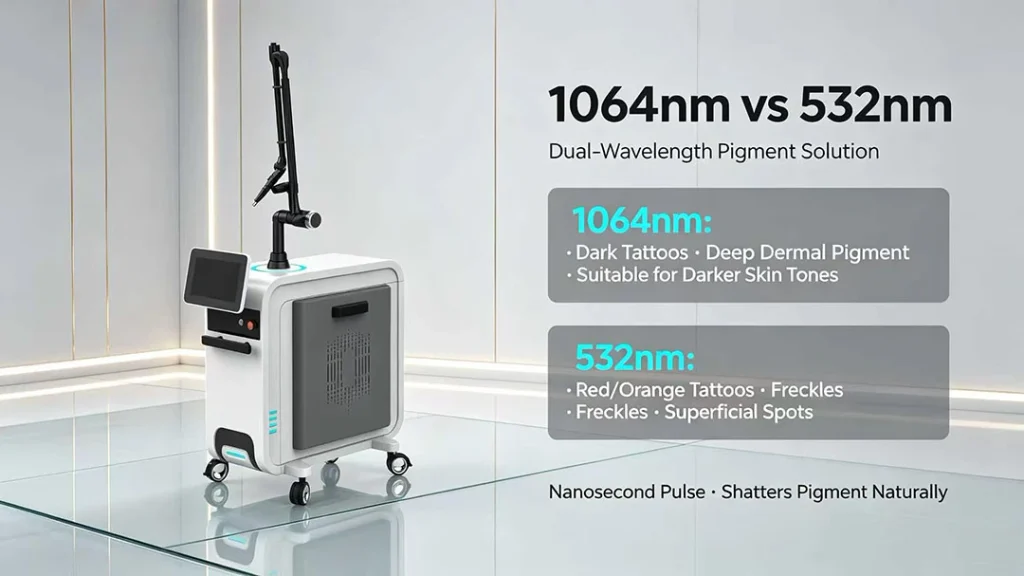
Dual-Wavelength Configuration for Different Pigment Conditions
One of the key advantages of HOMI’s Q-Switched Nd:YAG Laser System is its combination of 1064nm and 532nm wavelengths.
The 1064nm wavelength provides deeper penetration and is commonly used for dermal pigmentation and dark tattoo pigments, while the 532nm wavelength is suitable for superficial pigmentation and certain colored pigments.
This dual-wavelength design allows clinics to address different pigment depths and colors using one laser platform, reducing the need for multiple single-function devices.
Nanosecond Pulse Technology and High Energy Output for Pigment Fragmentation
HOMI’s system uses ultra-short nanosecond pulses with high peak energy to target pigment particles.
During treatment, laser energy is selectively absorbed by pigments, causing them to rapidly expand and fracture into smaller fragments. These fragments are gradually removed through the body’s natural metabolic processes.
With energy output up to 2000mJ and adjustable parameters controlled through the LCD interface, operators can optimize treatment settings according to different pigmentation conditions and clinical requirements.
Designed for Stable Operation in Professional Clinical Environments
Beyond laser performance, HOMI’s Q-Switched Nd:YAG Laser System incorporates practical features designed for daily clinical operation.
The system is equipped with a 12.1-inch color touch LCD screen, multilingual interface options, and fully adjustable software controls, allowing operators to manage treatment parameters conveniently.
Its combined air cooling, water cooling, and self-contained cooling system helps maintain stable operation during extended use. Meanwhile, the compact lightweight structure and durable aluminum alloy case make transportation and installation more convenient for clinics and distributors.
Multiple Applications for Aesthetic Clinics and Medical Spas
HOMI’s Q-Switched Nd:YAG Laser System supports a wide range of aesthetic applications, including:
- Tattoo pigment removal
- Eyebrow and lip line tattoo removal
- Freckles, sun spots, age spots, and pigmentation treatment
- Nevus of Ota and birthmark treatment
- Skin rejuvenation and carbon peel-related applications
By combining multiple wavelengths, adjustable parameters, and versatile applications, the system provides clinics with a practical solution for expanding treatment services while improving equipment utilization.
Frequently Asked Questions
Q1: What Is the Difference Between 1064nm and 532nm Q-Switched Nd:YAG Lasers?
A: The 1064nm wavelength provides deeper penetration and is commonly used for dark tattoo pigments and deeper pigmentation, while 532nm is more suitable for superficial pigmentation and certain colored tattoo inks. A dual-wavelength Q-Switched Nd Yag Laser combines both wavelengths for broader pigment treatment applications.
Q2: Can Q-Switched Nd:YAG Lasers Remove Different Tattoo Colors?
A: Yes. Different tattoo pigments absorb different wavelengths. Generally, 1064nm targets black and dark blue inks, while 532nm is often used for red and warm-colored pigments.
Q3: What Should Clinics Consider Before Buying a Q-Switched Nd:YAG Laser?
A: Clinics should evaluate wavelength options, energy stability, maintenance requirements, technical support, and long-term operating costs. The right system should match the clinic’s treatment needs and business goals.
Conclusion
Understanding the roles of 1064nm and 532nm wavelengths helps clinics and distributors better evaluate dual-wavelength Q-Switched Nd Yag Laser systems for pigment and tattoo removal applications.
A suitable laser platform should be selected based on treatment requirements, system reliability, maintenance considerations, and long-term business value.
With its dual 1064nm and 532nm wavelength configuration, HOMI’s Q-Switched Nd:YAG Laser System offers a versatile solution for professional aesthetic applications. Contact HOMI to explore a reliable Q-Switched Nd:YAG Laser solution for your pigment and tattoo removal needs.