Key Takeaways
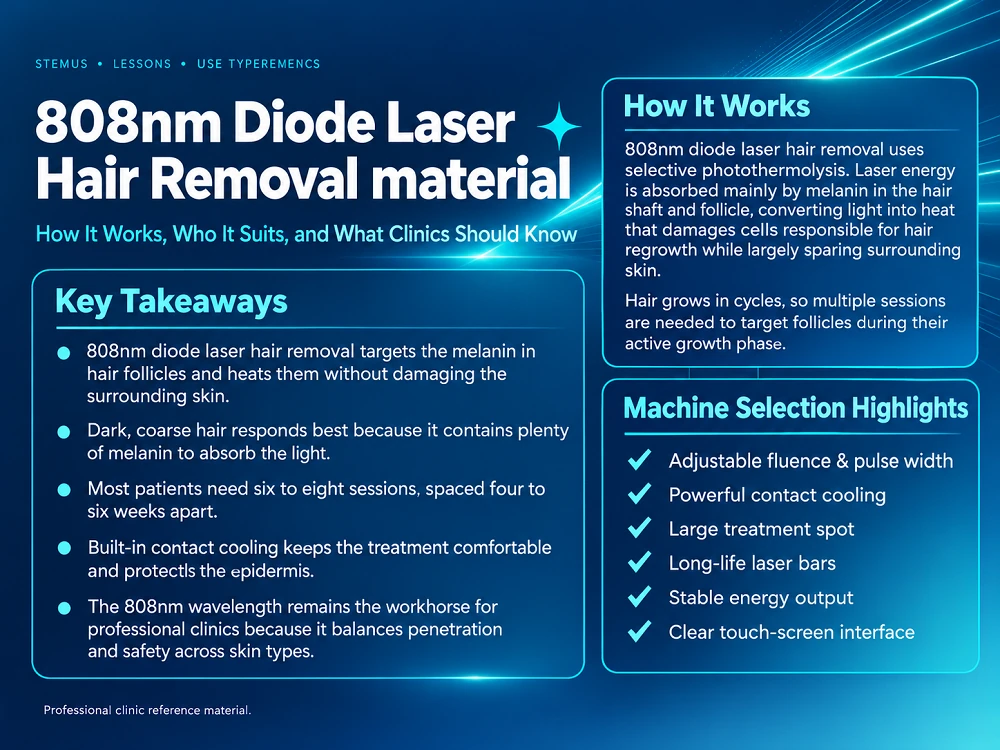
- 808nm diode laser hair removal targets the melanin in hair follicles and heats them without damaging the surrounding skin.
- Dark, coarse hair responds best because it contains plenty of melanin to absorb the light.
- Most patients need six to eight sessions, spaced four to six weeks apart.
- Built-in contact cooling keeps the treatment comfortable and protects the epidermis.
- The 808nm wavelength remains the workhorse for professional clinics because it balances penetration and safety across skin types.
Unwanted hair is one of the most common reasons people step into an aesthetic clinic. Shaving, waxing, and creams only postpone the problem for a few days or weeks, which is why professional laser hair removal has become a steady, high-volume service. Among the available wavelengths, 808nm diode laser hair removal remains one of the most widely used options worldwide. This guide explains how the treatment works, who benefits most, what a session feels like, and what clinics should look for when choosing a system.
How 808nm Diode Laser Hair Removal Works
The treatment relies on selective photothermolysis. A diode laser emits light at 808nm, and that light is absorbed mainly by the melanin inside the hair shaft and the follicle below. The absorbed light turns into heat, which raises the temperature of the follicle enough to damage the cells responsible for regrowth, while the surrounding skin is left largely untouched.
The 808nm wavelength sits in a practical middle ground. Shorter wavelengths are absorbed near the skin surface, while longer ones penetrate deeper but carry less energy. At 808nm, the light reaches the follicle bulb efficiently without heating the epidermis too much, and as a result this wavelength became the standard for professional hair removal.
Hair grows in cycles, and only the active anagen phase contains enough melanin and a fully formed follicle to respond to the laser. Since not every hair is in the same phase on the same day, one session can only treat the hairs currently active. Over repeated visits, the remaining resting hairs enter the active phase and are treated in turn. A full course therefore takes several months rather than a single appointment.
Who Is a Good Candidate
The best results come from a simple combination: dark, coarse hair on light to medium skin. Dark hair contains a high concentration of melanin, so it absorbs the laser energy strongly. For that reason, laser hair removal for dark hair works especially well, and patients with thick, coarse growth often see the fastest improvement.
Fine blonde, grey, red, or very light hair is a different story. These hairs carry little melanin, so the laser has little to target. Clinics should be honest with such patients: expectations need to be adjusted, and a series of sessions may produce only partial improvement.
Darker skin tones need a little more care but are not excluded. Compared with shorter wavelengths, 808nm is absorbed less aggressively by the melanin in the epidermis, which gives operators more room to treat deeper skin types safely. Fluence and pulse width are then adjusted to the patient’s skin tone, and tanned skin should be allowed to fade before a session. A test patch before the full treatment remains good practice.
What a Typical Session Looks Like
Preparation is simple. The treatment area should be shaved about 24 hours beforehand, and plucking, waxing, or threading should be avoided for several weeks, because those methods remove the follicle target. At the clinic, the area is cleaned, protective eyewear is worn, and the operator often starts with a small test patch.
During the session, the handpiece glides over the skin in overlapping passes. Most patients feel a quick warm sting, like the snap of a small rubber band. Modern machines use contact cooling that chills the skin before and during each pulse, which is what makes painless laser hair removal a realistic expectation rather than a marketing slogan. Treating both underarms takes about ten minutes; a full leg can take half an hour.
Afterwards, mild redness and a slight puffiness may last a few hours. Patients can usually return to normal activities the same day. Sun protection on the treated area is recommended for the following week.
Sessions, Results, and Maintenance
A full course usually calls for six to eight sessions, spaced four to six weeks apart. The gap allows the hair cycle to bring fresh follicles into the active phase. Patients often notice thinner and sparser growth after the first few visits, but the meaningful reduction appears only after the whole course.
Clinics should describe the outcome accurately. The industry describes long-term hair reduction rather than promising that every single hair will disappear forever. For patients hoping for permanent laser hair removal, the realistic picture is still favorable: after a full course, most patients enjoy lasting improvement, and the few hairs that return are usually finer and lighter. An occasional top-up session once or twice a year keeps the result smooth.
808nm Diode Laser vs Other Hair Removal Options
Patients often compare laser treatment with older methods. The table below sums up the main differences so a clinic can set clear expectations from the start.
Table 1. Professional hair removal methods at a glance
| Method | How It Works | Best For | Downtime | Skin Tones |
| 808nm diode laser | Light targets follicle melanin and heats the root | Dark coarse hair, large areas | None, mild redness for hours | Light to medium; adjustable for darker |
| Alexandrite 755nm | Shorter wavelength, faster on fair skin | Fair skin, large body areas | None | Limited on darker skin |
| Nd:YAG 1064nm | Deep penetration, low melanin absorption | Darker skin tones | None | Slower on fine hair |
| IPL / SHR | Broad-spectrum light | Mild reduction, budget settings | Minimal | Less precise, more sessions |
| Waxing / shaving | Physical removal at the surface | Temporary results | None | Temporary only |
No single tool wins on every patient. A fair-skinned patient with fine hair may feel perfectly served by Alexandrite or IPL, while a busy clinic that wants one reliable machine for the widest range of patients keeps returning to the 808nm diode platform.
Choosing an 808nm Diode Laser Hair Removal Machine for Your Clinic
Hair removal is a high-frequency service, so the machine a clinic chooses has to handle long days and repeated patients without dropping in performance. When a clinic evaluates an 808nm diode laser hair removal machine, a few features consistently separate reliable equipment from the rest.
What to Look For in a Machine
- Adjustable fluence and pulse width, so settings can match different hair thicknesses and skin tones.
- Strong contact cooling, ideally down to near freezing, for patient comfort and epidermis protection.
- A large treatment spot, which cuts the time spent on legs, backs, and other broad areas.
- Long-life laser bars built for continuous daily use.
- Steady output that stays consistent through long treatment days.
- A clear touchscreen interface so staff can adjust settings quickly between patients.
A Machine Built for High-Volume Clinics
One example of equipment designed around these needs is the EON Laser 1200W High Intensity Diode Hair Removal System. It delivers a fixed 808nm wavelength at 1200W, with fluence adjustable from 20 to 80 J/cm², pulse width from 10 to 100 ms, and a frequency up to 10 Hz, so the operator can tune every treatment to the hair type and skin tone in front of them. The module uses imported laser bars for long service life and a waveguide-free beam design that spreads the energy evenly across the spot.
Comfort and speed are built in as well. The handpiece offers 360-degree contact cooling that reaches about minus 15 degrees Celsius, combining TEC, water, and air cooling to keep the epidermis protected during every pulse. An exchangeable large spot size shortens sessions on broad areas, while a 15.6-inch touchscreen keeps settings easy to manage. For a clinic running several hair removal treatments a day, these details add up to faster turnaround, comfortable patients, and consistent results week after week.
Frequently Asked Questions
How many sessions of 808nm diode laser hair removal are needed?
Most patients need six to eight sessions, spaced four to six weeks apart, depending on the body area and hair growth cycle. Visible thinning usually begins after the first few visits, and the full result is judged after the complete course.
Does 808nm diode laser hair removal hurt?
With contact cooling, most patients describe the feeling as brief warmth or a light snap rather than pain. Comfort improves as the handpiece chills the skin before each pulse, and sensitivity varies by body area.
Is 808nm laser safe for darker skin?
Yes, when settings are adjusted correctly. The 808nm wavelength is absorbed less aggressively by epidermal melanin than shorter wavelengths, which makes it a common choice for darker skin tones. A test patch and trained operation remain essential.
Does 808nm laser work on blonde or grey hair?
Poorly. These hair colors contain little melanin, so the laser has almost nothing to target. Patients with light blonde, grey, or red hair should set realistic expectations and discuss alternatives with the practitioner.
Conclusion
808nm diode laser hair removal remains the backbone of professional hair removal because it combines a well-understood mechanism, broad suitability across patients, and short treatment times. It rewards clinics that explain the process honestly, set clear session expectations, and equip themselves with a machine built for daily use.
For a clinic looking to add or upgrade this service, the business case is straightforward: steady demand, repeat patients, and comfortable treatments that pair naturally with other skin services. If you are considering a professional diode laser system for your practice, contact us to discuss options built for high-volume hair removal and how to set up the service confidently.