Introduction
Spider veins, medically known as telangiectasias, are among the most common cosmetic concerns encountered in dermatology and aesthetic medicine. These tiny, dilated blood vessels form web-like patterns just beneath the skin’s surface, most frequently appearing on the face and lower legs. Their prevalence is substantial—approximately 60% of adults have spider and reticular veins, making these conditions more common than diabetes mellitus and comparable to the occurrence of high blood pressure among adults in the United States.
While spider veins are generally benign and rarely produce severe medical symptoms, many patients report discomfort, burning sensations, itching, or leg fatigue. For an even larger number of individuals, these visible vascular irregularities pose a significant aesthetic concern that impacts daily confidence and quality of life.
Laser therapy has established itself as the non-invasive standard of care for vascular lesion treatment in modern aesthetic practice. Among the various laser technologies available, diode laser systems operating at specific near-infrared wavelengths have demonstrated superior clinical outcomes. This article examines why 980nm diode laser for vascular removal and its synergistic partner at 1470nm are clinically validated as optimal solutions for clearing spider veins and related vascular abnormalities.
Understanding Spider Veins: The Importance of Professional Diagnostics
What Causes Facial and Leg Spider Veins?
Spider veins develop when small blood vessels beneath the skin become dilated and remain persistently open, accumulating visible blood volume. Several factors contribute to this process:
- Genetic predisposition: Family history plays a dominant role in vein wall weakness and valve dysfunction
- Hormonal influences: Pregnancy, oral contraceptive use, and hormonal changes associated with menopause
- Prolonged standing or sitting: Occupations requiring extended periods of stationary posture increase venous pressure
- Ultraviolet exposure: Chronic sun damage weakens dermal collagen and elastin, contributing to facial telangiectasia
- Aging: Cumulative mechanical stress on venous walls and natural tissue degeneration
- Trauma or prior injury: Localized damage to venous structures
On the face, repeated ultraviolet exposure and rosacea-related inflammation are leading triggers. On the legs, gravitational pressure and incompetent “feeder” reticular veins (typically 1–3 mm in diameter located deeper in the subdermal layer) commonly supply superficial spider vein clusters.
Why Pre-Treatment Analysis is Essential for Clinical Success
Before any laser intervention, comprehensive skin and vascular assessment is essential. The depth, diameter, feeding vessel pattern, and density of target vessels directly determine optimal treatment parameters—including wavelength selection, fluence, pulse duration, and spot size.
This is where diagnostic technology becomes indispensable. A high-quality Skin Analyzer Machine enables practitioners to objectively evaluate subsurface vascular structures, melanin distribution, and dermal health prior to laser exposure. Systems employing multispectral imaging and RBX (Red/Brown Subsurface Analysis) technology can specifically identify hemoglobin-rich vascular lesions by detecting red color signatures beneath the epidermis, providing quantifiable data that guides treatment planning and monitors therapeutic response.
When investing in diagnostic equipment, aesthetic clinics should partner with a reputable Skin Analyzer Manufacturer that provides validated imaging systems with calibrated accuracy . Homilaser supplies precision skin analysis solutions that integrate seamlessly with clinical laser workflows, ensuring diagnostic data is both reliable and actionable before proceeding to vascular treatment.
The Science Behind: Why 980nm & 1470nm Wavelengths Work Best
The Principle of Selective Photothermolysis
Laser vascular removal is governed by the principle of selective photothermolysis—a concept that uses specific wavelengths of light to selectively target and treat unwanted structures without damaging surrounding healthy tissue.
For vascular lesions, the primary chromophore is hemoglobin, the oxygen-carrying protein within red blood cells. When laser light is absorbed by hemoglobin, the energy is converted into heat. This thermal elevation coagulates blood proteins and damages the endothelial lining of the vessel wall, causing the targeted vessel to collapse. Over subsequent weeks, the body’s immune system naturally reabsorbs the thrombosed tissue through phagocytosis.
Successful selective photothermolysis requires careful matching of wavelength to the target’s absorption spectrum, pulse duration to the target’s thermal relaxation time, and fluence sufficient to achieve irreversible vascular damage while preserving the epidermis.
980nm vs. Other Wavelengths: What Makes It Distinct?
Shorter visible wavelengths such as 532nm KTP and 585nm pulsed dye lasers are highly absorbed by superficial hemoglobin, making them effective for very fine facial telangiectasias. However, their shallow penetration depth (approximately 0.5–1.2 mm) limits efficacy for deeper vessels, reticular “feeder” veins, or leg spider veins situated deeper within the dermis.
Conversely, longer near-infrared wavelengths like 1064nm Nd:YAG penetrate more deeply (4–6 mm) but exhibit relatively weak hemoglobin absorption, requiring higher fluences that increase thermal diffusion and the risk of post-operative discomfort and purpura.
The 980nm diode laser for vascular removal achieves an optimal balance. Scientific data indicate that wavelengths of 810nm, 940nm, and 980nm have significantly higher rates of absorption by hemoglobin compared to longer alternatives. Furthermore, components of blood—particularly oxyhemoglobin—absorb 980nm radiation more effectively than other common laser wavelengths, including 810nm and 1064nm.
Additionally, the 980nm wavelength has increased water absorption compared with 810nm diode and 1064nm Nd:YAG lasers, producing an efficient surface effect that enhances coagulation of superficial vessels. This dual-targeting capability (hemoglobin plus water) makes the 980nm wavelength uniquely suited for treating both small-caliber facial vessels and slightly deeper leg telangiectasias.
The Synergistic Effect of the 1470nm Wavelength
While 980nm is hemoglobin-selective, the 1470nm wavelength shifts the chromophore preference toward water. Since soft tissue is approximately 70–80% water, the 1470nm wavelength is strongly absorbed by water within the vein wall itself, enabling precise and controlled thermoablative action directly upon vascular structures.
The 1470nm infrared laser diode exhibits approximately 40 times greater water absorption than the traditional vein treatment laser of 980nm, which contributes to significantly less post-operative pain and reduced bruising and swelling. In endovenous applications, the 1470nm device has demonstrated superior truncal vein and great saphenous vein occlusion outcomes compared to the 980nm device at early, one-year, and medium to long-term follow-up intervals.
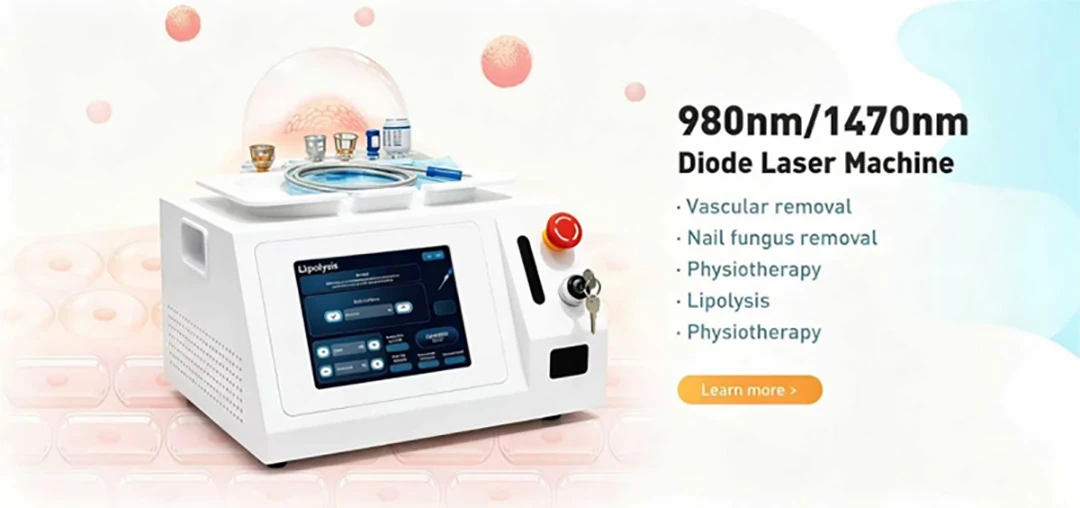
When combined in a dual-wavelength platform, the 980nm diode laser for vascular removal provides robust hemoglobin absorption for effective coagulation of visible spider veins, while the 1470nm wavelength complements this by efficiently heating water within the vessel wall, ensuring thorough thermal damage with minimal energy expenditure. Clinical data from a study treating 497 vascular lesions found that the dual 980-nm/1470-nm diode laser achieved 100% complete clearance in cherry angiomas, venous lakes, lip hemangiomas, and spider nevi after a single treatment. No adverse events were recorded, confirming the safety profile of this combined approach.
Key Advantages of a Professional 980nm/1470nm Spider Veins Machine
High Precision and Targeted Treatment
A professionally engineered Spider Veins Machine employing dual-wavelength diode laser technology delivers exceptional targeting precision. Fine optical fibers and engineered spot sizes allow energy delivery to be confined within the vessel lumen, minimizing thermal spread to perivascular tissues.
The 980nm component is preferentially absorbed by intraluminal hemoglobin, generating steam bubbles that induce thrombotic occlusion. The 1470nm component, with its high water absorption coefficient, ensures energy is deposited within the vein wall itself, creating a controlled thermal effect that collapses the vessel from both inside and outside simultaneously.
For practitioners, this means fewer unwanted side effects, reduced epidermal injury risk, and the ability to treat overlapping vascular networks without cumulative thermal damage.
Clinically Proven Efficacy and Minimal Downtime
The 980nm diode laser has been objectively evaluated in clinical settings. In a study of thirty patients treated with a long-pulse 980nm diode laser (150 ms pulse, 300–500 J/cm²), 60% of patients achieved up to 50% improvement in facial telangiectasia, leg veins, venous lakes, and spider nevi. With optimized parameters and integrated surface cooling, patient discomfort can be significantly reduced while maintaining clinical efficacy.
The combined 980nm/1470nm approach further enhances this profile. Because the 1470nm wavelength deposits energy more efficiently into water-dense vascular structures, lower total fluences can be used to achieve comparable or superior vessel closure, reducing intra-procedural pain and accelerating recovery. Most patients experience only transient erythema and mild edema lasting 24 to 72 hours, with no mandatory downtime. Return to normal activities—including work and social engagements—typically occurs immediately following treatment.
Multi-scenario Application (Face & Legs)
A quality 980nm Diode Laser Spider Vein Removal Machine with dual-wavelength capability offers remarkable versatility:
This multi-scenario adaptability makes a dual-wavelength Spider Veins Machine a high-ROI investment for medical aesthetic clinics, capable of addressing the majority of vascular complaints encountered in daily practice.
What to Expect During and After the Laser Vascular Treatment?
The Treatment Protocol: Step-by-Step
A professional laser vascular treatment session typically follows this structured workflow:
- Cleansing and documentation: The treatment area is thoroughly cleansed, and baseline photography is obtained for comparison.
- Diagnostic assessment: A Skin Analyzer Machine is used to visualize subsurface vascular patterns, identify feeder vessels, and confirm vessel depth.
- Parameter selection: Based on vessel diameter, depth, skin phototype, and anatomical location, the practitioner selects appropriate wavelength(s), fluence, pulse duration, and spot size. Professional systems like those from Homilaser offer intelligent preset parameters to guide clinicians.
- Cooling and positioning: Contact cooling or a chilled tip is applied to protect the epidermis. The handpiece is positioned perpendicular to the skin surface.
- Precision irradiation: The laser is delivered in a grid or linear pattern, carefully overlapping pulses to ensure complete vascular coverage without excessive energy deposition.
Treatment duration varies by area size: a small facial area may take 5–10 minutes, while bilateral lower leg treatment may require 20–30 minutes.
Post-Treatment Care and Recovery Tips
To optimize outcomes and minimize transient side effects, patients should follow these guidelines:
- Sun protection: Strictly avoid direct sun exposure for 4–6 weeks post-treatment and apply broad-spectrum SPF 30+ sunscreen daily.
- Gentle cleansing: Use mild, non-irritating cleansers; avoid scrubbing, hot water, or exfoliants for 48 hours.
- Avoid strenuous exercise: Refrain from high-intensity activities and prolonged standing for 2–3 days to minimize venous pressure.
- Compression (if indicated): For leg vein treatments, light compression stockings may be recommended for 3–7 days.
- Hydration: Maintain adequate oral hydration to support tissue healing.
Treated vessels typically darken slightly within the first 24–48 hours as thrombosis occurs, then gradually fade over 2–6 weeks. Some patients may experience temporary erythema, mild edema, or a “cat scratch” sensation—all of which resolve spontaneously.
Conclusion
The scientific and clinical evidence supporting 980nm and 1470nm diode lasers for spider vein removal is robust. The 980nm diode laser for vascular removal offers balanced hemoglobin absorption and moderate tissue penetration, making it effective for a wide range of facial and leg telangiectasias. The 1470nm wavelength, with its superior water absorption, provides a synergistic effect that enhances vessel wall coagulation, reduces pain, and improves long-term occlusion outcomes.
Successful clinical outcomes, however, depend not only on wavelength selection but also on proper pre-treatment assessment (aided by a reliable skin analyzer machine), appropriate patient selection, and precise parameter customization. Furthermore, investing in equipment supplied by a credible Skin Analyzer Manufacturer ensures diagnostic accuracy and treatment consistency.
Frequently Asked Questions (FAQ)
Q1: How many treatments are typically needed for spider vein removal?
A: Superficial facial telangiectasias may resolve in 1–3 sessions. Leg spider veins often require 2–4 sessions spaced 4–6 weeks apart due to deeper vessel involvement and gravitational factors. For cherry angiomas and spider nevi, complete clearance after a single treatment has been documented with dual-wavelength 980/1470nm systems.
Q2: Is the treatment painful?
A: Mild to moderate discomfort, often described as a rubber band snap against the skin, is typical during laser delivery. Modern systems incorporate contact cooling or chilled air to minimize pain. Following treatment, mild warmth or tenderness may persist for several hours but is well-tolerated without requiring analgesics.
Q3: Are there any side effects?
A:Common transient effects include erythema, mild edema, and slight darkening of treated vessels. Purpura (bruising) is less frequent with 1470nm wavelengths due to water-targeted coagulation. Serious adverse events are rare when treatment is performed by trained professionals using appropriate parameters and epidermal cooling.
Q4: Can all skin types be treated?
A: Diode lasers at 980nm and 1470nm are generally suitable for Fitzpatrick skin types I–IV. For darker skin types (V–VI), increased risk of post-inflammatory hyperpigmentation requires cautious parameter selection, longer pulse durations, and vigorous epidermal protection.
Q5: How long do results last?
A: Successfully treated vessels are permanently eliminated and will not recur. However, new spider veins may develop over time due to ongoing genetic predisposition, hormonal influences, or lifestyle factors. Maintenance treatments may be considered for individuals prone to progressive venous changes.