Skin resurfacing technology continues to evolve as aesthetic clinics look for solutions that combine treatment precision, operational flexibility, and reliable performance. Among different laser technologies, fractional CO2 laser systems have become a widely used option for professional skin resurfacing applications.
However, choosing a suitable laser system requires more than comparing basic specifications. Clinics need to evaluate factors such as laser source stability, energy delivery modes, scanning precision, cooling configuration, and supplier support before making an investment decision.
This guide explains the working principle of fractional CO2 laser technology, key factors to consider when selecting equipment, and how professional clinics can evaluate a reliable fractional CO2 laser equipment solution.
Why Fractional CO2 Laser Has Become a Popular Skin Resurfacing Solution for Clinics
Fractional CO2 laser technology has become an important option for professional skin resurfacing applications because it provides precise energy delivery and flexible treatment control. Compared with traditional resurfacing approaches that treat larger continuous areas, fractional technology allows clinics to create controlled treatment patterns while maintaining better management of treatment intensity and coverage.
Understanding how fractional CO2 laser works and why it is different from traditional CO2 laser resurfacing can help clinics make better decisions when evaluating laser systems.
Understanding the Working Principle of Fractional CO2 Laser Technology
A fractional CO2 laser system uses CO2 laser energy to create controlled treatment zones within the target skin area. Unlike traditional CO2 laser resurfacing, which applies energy across a larger continuous surface, fractional technology divides the laser output into multiple microscopic beams.
Each fractional laser beam creates a small thermal treatment zone, while surrounding untreated tissue remains available to support the natural repair process. This approach allows practitioners to control energy distribution more precisely and adjust treatment coverage according to different application requirements.
The fractional delivery method makes CO2 laser technology more flexible for professional skin resurfacing procedures, including skin texture improvement, scar treatment, and rejuvenation applications.
Why 10600nm CO2 Laser Is Used for Skin Resurfacing
The wavelength of a laser system determines how laser energy interacts with biological tissue. CO2 laser systems commonly operate at a wavelength of 10600nm, which is strongly absorbed by water molecules contained in human tissue.
During treatment, the absorbed laser energy is converted into thermal energy, producing controlled effects such as tissue vaporization and coagulation based on the selected parameters. This interaction allows the laser system to precisely affect targeted areas while supporting the natural remodeling process after treatment.
For clinics evaluating a fractional CO2 laser machine, understanding the relationship between wavelength and tissue interaction is important when comparing different equipment configurations and application capabilities.
Fractional CO2 Laser vs Traditional CO2 Laser Resurfacing
Before investing in laser equipment, clinics should understand the differences between fractional CO2 laser technology and traditional CO2 resurfacing approaches.
| Feature | Fractional CO2 Laser | Traditional CO2 Laser Resurfacing |
| Energy delivery | Fractional micro-beam patterns | Larger continuous treatment areas |
| Treatment control | Adjustable treatment coverage and energy parameters | More extensive surface treatment |
| Tissue interaction | Controlled treatment zones | Full-area laser ablation |
| Application flexibility | Suitable for various resurfacing applications | More limited adjustment options |
By dividing laser energy into fractional treatment patterns, fractional CO2 laser technology provides more precise control compared with traditional CO2 resurfacing methods. This flexibility makes it a widely considered solution for clinics looking to provide advanced skin resurfacing services.
Key Factors to Consider When Choosing a Fractional CO2 Laser Machine
Selecting a professional fractional CO2 laser machine requires careful evaluation of technical specifications, treatment requirements, and long-term operational considerations.
For aesthetic clinics, the right equipment should not only provide stable laser performance but also offer flexible treatment options, reliable operation, and suitable support from an experienced manufacturer.
Several key factors should be considered before investing in a fractional CO2 laser system.
Laser Source and Energy Stability
The laser source is one of the most important components affecting equipment performance and energy consistency.
When evaluating a fractional CO2 laser equipment solution, clinics should consider:
- Laser tube type
- Output stability
- Energy delivery consistency
- Long-term operational reliability
A stable laser source helps ensure that laser energy can be delivered according to the selected treatment parameters. Consistent energy output is especially important for professional clinics that require reliable performance across different treatment applications.
Treatment Modes and Pulse Control Options
Different skin resurfacing applications may require different energy delivery methods. Therefore, adjustable output modes are an important factor when selecting a CO2 laser system.
Professional fractional CO2 laser systems may offer multiple pulse options, such as:
- Continuous wave (CW)
- Single pulse
- Interval pulse
- Super pulse
These different modes allow practitioners to adjust energy delivery based on treatment requirements. A system with flexible pulse control can provide greater versatility for clinics offering multiple skin resurfacing procedures.
Scanning System and Treatment Precision
The scanning system determines how laser energy is distributed across the treatment area and directly affects treatment flexibility.
When choosing a fractional CO2 laser machine, clinics should evaluate:
- Scanning accuracy
- Available scan patterns
- Adjustment flexibility
- Ease of operation
A versatile scanning system allows practitioners to select suitable treatment patterns for different areas and application requirements. Multiple scanning options can improve equipment adaptability in daily clinical workflows.
Cooling System and Equipment Reliability
The cooling configuration is another important consideration when evaluating laser equipment.
During fractional CO2 laser operation, controlled thermal energy is delivered into the treatment area. A suitable cooling system helps maintain stable equipment performance and supports reliable operation during professional use.
Clinics should consider:
- Cooling method
- System stability during operation
- Maintenance requirements
- Suitability for continuous clinical workflows
A well-designed cooling system contributes to overall equipment reliability and helps maintain consistent operating conditions.
Maintenance Requirements and Supplier Support
When purchasing laser equipment, clinics should consider more than the technical specifications of the device itself. Long-term maintenance, technical support, and supplier reliability are also important factors.
A reliable fractional CO2 laser machine supplier should be able to provide professional assistance throughout the equipment lifecycle.
Before making a purchasing decision, buyers should evaluate:
- Manufacturer experience
- Technical support capability
- Customization options
- Long-term cooperation potential
Choosing the right supplier can help clinics ensure smoother equipment operation and establish a more stable long-term partnership.
Common Applications of Fractional CO2 Laser in Aesthetic Clinics
Fractional CO2 laser technology is applied in various aesthetic and dermatological procedures due to its precise energy delivery and ability to support skin remodeling processes.
The actual treatment parameters should be selected according to professional assessment and specific application requirements.
Acne Scar Treatment and Skin Texture Improvement
Acne scars often involve uneven skin structure and surface texture. Fractional CO2 laser treatment creates controlled micro-treatment areas that can stimulate natural skin repair responses.
Through the skin remodeling process, fractional treatment is commonly used in professional settings to improve the appearance of acne scars and enhance overall skin texture.
Wrinkle Reduction and Skin Rejuvenation
Changes in collagen structure are one of the factors associated with skin aging. Fractional CO2 laser technology uses thermal stimulation to support collagen restructuring and improve the appearance of fine lines and uneven skin texture.
For aesthetic clinics, this makes fractional CO2 laser systems a versatile option for skin rejuvenation applications.
Pigmentation and Scar Revision Treatments
Fractional CO2 laser systems can also be used for different skin resurfacing applications related to pigmentation concerns and scar improvement.
Common applications include:
- Freckle and pigmentation-related treatments
- Depressed scars
- Old scars
- Diffuse scars
- Fibrous scars
- Stretch mark improvement
The flexibility of laser parameters allows practitioners to adjust treatment settings according to different application needs.
Vaginal Tissue Remodeling Applications
In addition to skin resurfacing applications, fractional CO2 laser technology can also be used in vaginal tissue treatment procedures.
The treatment principle involves delivering controlled thermal energy into targeted tissue layers. The thermal stimulation activates tissue repair responses and supports collagen and elastin remodeling.
For clinics providing related services, selecting a system with precise energy control and adjustable parameters is important to ensure suitable treatment customization.
FraxRe Fractional CO2 Laser Machine: A Professional Solution for Skin Resurfacing Clinics
For clinics, distributors, and aesthetic equipment companies looking for a reliable fractional CO2 laser machine supplier, FraxRe provides a professional fractional CO2 laser solution designed for skin resurfacing applications.
Instead of focusing only on basic laser output, FraxRe combines a stable RF Tube laser source, flexible treatment modes, and multiple scanning options to support different professional application requirements.
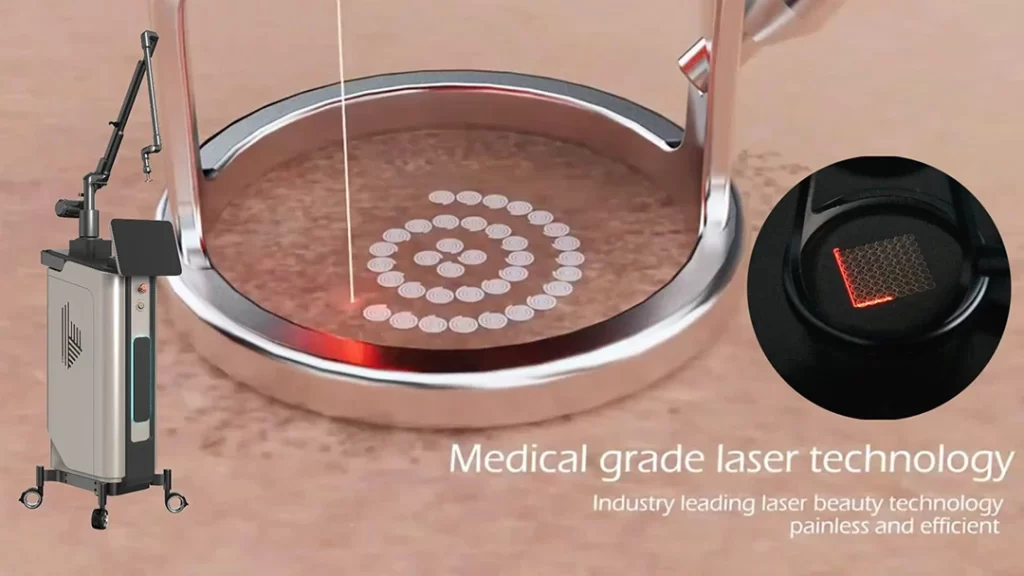
Technical Features of FraxRe Fractional CO2 Laser System
| Parameter | Specification |
| Laser Type | RF Tube 60W Fractional CO2 Laser |
| Wavelength | 10600nm |
| Light Guide System | 7-Articulation Joint Spring Arm |
| Laser Output Mode | CW, Single Pulse, Interval Pulse, Super Pulse |
| Scan Shape | Square, Rectangle, Circle, Triangle, Hexagon, Ellipse, Line |
| Indication Beam | Red Diode Laser (650nm, ≤5mW) |
| Smoke Exhausting System | Built-in Air Blow |
| Cooling System | Air Cooling |
| Electrical Requirement | AC 220V ±10% 50HZ / AC 110V ±10% 60HZ |
The technical configuration provides flexibility for professional users who require adjustable laser parameters and versatile scanning patterns.
OEM/ODM and Factory Direct Supply Support
For B2B buyers, supplier capability is an important part of equipment selection.
FraxRe provides:
OEM / ODM Support
Customization options are available for:
- Branding requirements
- System interface customization
- Exterior design adjustments
Factory Direct Supply
Direct factory supply supports consistent production quality and communication efficiency for business cooperation.
Reliable Technical Support
Professional after-sales service and long-term maintenance assistance help customers manage equipment operation after purchase.
Frequently Asked Questions
Q1: What makes fractional CO2 laser different from traditional CO2 laser treatments?
A: Fractional CO2 laser delivers laser energy through microscopic treatment zones instead of treating the entire skin surface. This approach creates controlled thermal areas while preserving surrounding tissue.
Q2: What wavelength does a fractional CO2 laser machine use?
A: A fractional CO2 laser machine typically operates at a wavelength of 10600nm. In FraxRe’s system, the 10600nm CO2 laser wavelength is used for controlled tissue vaporization and thermal stimulation.
Q3: Can fractional CO2 laser parameters be adjusted for different treatments?
A: Yes. The FraxRe Fractional CO2 Laser System provides adjustable output modes, including CW, single pulse, interval pulse, and super pulse modes. It also supports multiple scanning shapes for different treatment requirements.
Conclusion
Choosing the right fractional CO2 laser system requires a comprehensive evaluation of laser technology, energy control, scanning precision, cooling configuration, and supplier capability.
For aesthetic clinics and professional treatment providers, a reliable fractional CO2 laser equipment solution should offer stable performance, flexible treatment options, and long-term technical support.
With its 10600nm RF tube laser source, fractional beam distribution, adjustable output modes, and versatile scanning system, FraxRe Fractional CO2 Laser Machine provides a professional option for clinics looking to expand their skin resurfacing capabilities.
When selecting a fractional CO2 laser machine supplier, clinics and distributors should focus not only on equipment specifications but also on manufacturing expertise, customization support, and after-sales service to ensure long-term cooperation.