Introduction
For aesthetic clinics, choosing the right skin rejuvenation technology is not only about treatment performance—it is also about offering effective solutions for different patient concerns. Many clinics face a common challenge: should they invest in a Fractional CO2 laser system for advanced skin resurfacing, or choose a Microneedling RF machine for deeper tissue stimulation and skin tightening?
Although both technologies are designed to improve skin quality and stimulate collagen remodeling, they work through different mechanisms. Fractional CO2 laser resurfacing uses controlled laser energy to create microscopic treatment zones, helping improve skin texture and promote collagen renewal. In contrast, Microneedling RF delivers radiofrequency energy through microneedles to heat targeted tissue layers and support skin tightening.
The right choice depends on a clinic’s treatment goals, patient needs, and service offerings. This guide will compare Fractional CO2 laser and Microneedling RF based on their working principles, applications, and equipment features to help aesthetic professionals make informed decisions.
How Does Fractional CO2 Laser Work?
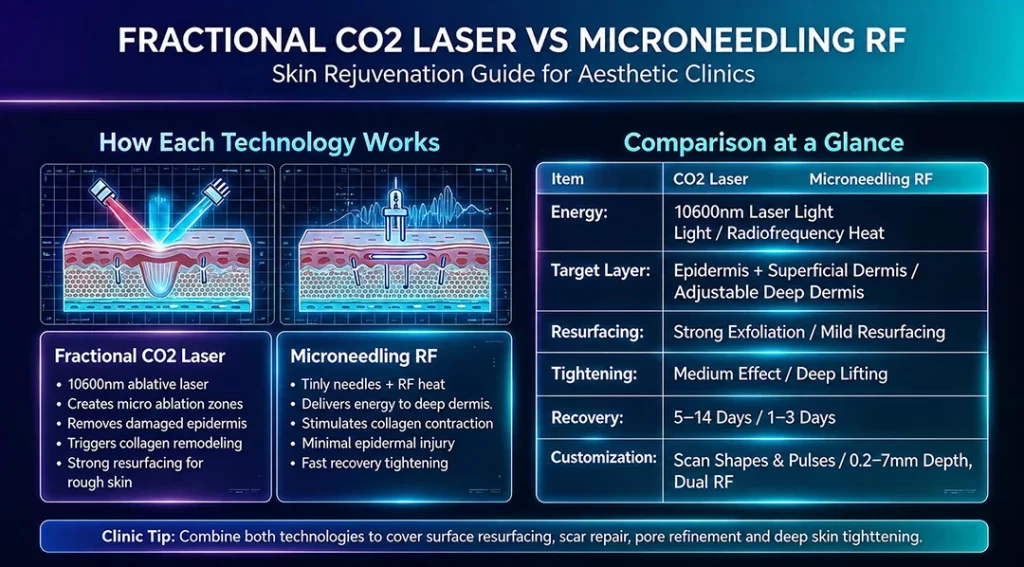
Fractional CO2 laser is an ablative laser resurfacing technology that uses controlled thermal energy to improve skin texture and promote collagen remodeling.
A CO2 laser operates at a wavelength of 10600nm, which is strongly absorbed by water molecules in the skin tissue. During treatment, the laser creates microscopic treatment zones in the skin, removing targeted superficial tissue while preserving surrounding areas.
These controlled thermal zones trigger the skin’s natural healing response. The surrounding untreated tissue supports recovery, while the heat generated by the laser stimulates collagen production and remodeling, helping improve skin texture, firmness, and overall appearance.
Compared with traditional full-field CO2 laser treatments, fractional delivery creates multiple microscopic treatment zones instead of treating the entire skin surface at once. This allows for more precise Fractional CO2 laser resurfacing with controlled thermal effects, faster healing, and reduced downtime.
How Does Microneedling RF Work?
Microneedling RF combines microneedling with radiofrequency energy to deliver controlled thermal stimulation into targeted skin layers.
During treatment, fine needles create precise micro-channels in the skin while RF energy delivers controlled thermal stimulation at adjustable depths. This combination promotes collagen contraction and long-term remodeling within deeper tissue layers while preserving the surrounding skin structure.
Unlike laser resurfacing technologies that deliver energy through focused light beams, Microneedling RF uses needle electrodes to directly deliver radiofrequency energy into targeted tissue layers. This allows practitioners to customize treatment depth and energy delivery according to different skin concerns.
Modern RF microneedling systems, including professional RF Microneedling Machines, provide adjustable treatment depths and various needle configurations, allowing practitioners to customize treatments for different areas and patient needs.
Key Differences Between Fractional CO2 Laser and Microneedling RF
| Feature | Fractional CO2 Laser | Microneedling RF |
| Energy source | 10600nm CO2 laser energy | Radiofrequency energy |
| Main mechanism | Ablative fractional resurfacing and controlled thermal stimulation | Microneedle penetration combined with RF energy delivery |
| Primary target | Epidermal renewal and dermal collagen remodeling | Deeper dermal remodeling and skin tightening |
| Treatment depth | Epidermal and superficial dermal layers | Adjustable based on needle penetration depth |
| Skin resurfacing ability | Strong resurfacing effect | Moderate resurfacing effect |
| Scar improvement | Common application | Common application |
| Skin tightening | Supports collagen remodeling and skin texture improvement | Designed for deeper dermal heating and skin tightening |
| Typical downtime | Around 5–14 days, depending on treatment intensity and settings | Around 1–3 days, depending on treatment depth and energy levels |
| Treatment customization | Scan patterns and laser parameters | Needle types, depths, and energy settings |
Both technologies can support collagen remodeling, but they approach skin rejuvenation from different directions. The better choice depends on the specific treatment objective rather than one technology being universally superior.
Fractional CO2 Laser vs Microneedling RF for Acne Scars
Acne scars are one of the most common skin concerns addressed with professional skin rejuvenation treatments. Since acne scars can range from superficial textural irregularities to deeper depressed scars, treatment selection often depends on scar type, skin condition, and desired outcomes.
When considering RF microneedling for acne scars, practitioners often evaluate whether deeper dermal stimulation, controlled energy delivery, and shorter downtime match the patient’s skin condition and treatment goals. In comparison, Fractional CO2 laser is commonly used for skin resurfacing and improving overall texture through controlled fractional ablation.
Fractional CO2 Laser for Acne Scars
Fractional CO2 laser is commonly used for acne scars characterized by:
- Uneven skin texture
- Depressed scars
- Surface irregularities
- Overall skin texture improvement
By creating microscopic laser treatment zones, Fractional CO2 laser removes tiny columns of tissue while stimulating the skin’s natural healing response. This controlled thermal effect encourages collagen production and remodeling, which may help improve the appearance of acne scar texture over a series of treatments.
Fractional CO2 laser is often used for mild to moderate atrophic acne scars, particularly when patients are seeking more intensive resurfacing and texture improvement.
Microneedling RF for Acne Scars
Microneedling RF may be suitable for patients seeking:
- Acne scar texture improvement
- Enlarged pore reduction
- Deeper dermal stimulation
- Skin tightening effects
The combination of needle penetration and RF energy allows controlled heat delivery into targeted tissue layers. By adjusting needle depth and energy settings, practitioners can customize treatment according to different skin conditions and treatment areas.
Compared with ablative fractional laser resurfacing, RF microneedling for acne scars focuses on delivering thermal energy into deeper dermal layers while maintaining minimal surface disruption, making it an option for patients who prefer shorter recovery periods.
Fractional CO2 Laser vs Microneedling RF for Skin Tightening and Anti-Aging
Age-related skin changes are often associated with reduced collagen production, fine lines, uneven texture, and gradual loss of skin firmness. For aesthetic clinics, choosing between Fractional CO2 laser and Microneedling RF often depends on whether the primary goal is surface renewal, collagen remodeling, or deeper dermal tightening.
Fractional CO2 Laser for Skin Tightening and Anti-Aging
When used for skin laxity concerns, Fractional CO2 laser technology creates microscopic treatment zones within the skin through controlled laser energy delivery. The thermal effect stimulates the skin’s natural healing response and promotes collagen remodeling, making it commonly used for improving fine lines, uneven texture, and overall skin appearance.
As an ablative fractional resurfacing technology, Fractional CO2 laser is particularly useful when photoaging, rough texture, and surface irregularities are major concerns. By creating microscopic columns of controlled ablation and stimulating the skin’s wound-healing response, it supports gradual improvement in skin smoothness and firmness over a series of treatments.
Microneedling RF for Skin Tightening
RF microneedling for skin tightening combines microneedle penetration with radiofrequency energy delivery to provide controlled thermal stimulation at adjustable depths. By customizing needle depth and energy settings, practitioners can target different tissue layers to support collagen contraction and remodeling.
Microneedling RF is often considered for patients with concerns such as mild to moderate skin laxity, reduced firmness, enlarged pores, and areas requiring deeper dermal tightening. Compared with primarily resurfacing-focused treatments, its adjustable-depth energy delivery allows practitioners to customize treatment based on different skin conditions and treatment areas.
Professional Skin Rejuvenation Solutions with Fractional CO2 Laser and Microneedling RF
FraxRe Fractional CO2 Laser System
Designed for professional skin resurfacing applications, the FraxRe Fractional CO2 Laser System utilizes 10600nm CO2 laser technology with an RF Tube 60W fractional CO2 laser source to deliver controlled ablative treatment.
The system creates microscopic laser treatment zones to support skin renewal while preserving surrounding untreated tissue. Its adjustable scanning system allows practitioners to customize treatment patterns according to different facial and body treatment areas.
Supported scan shapes include:
- Square
- Rectangle
- Circle
- Triangle
- Hexagon
- Ellipse
- Line
The system is equipped with a 7-articulation joint spring arm for stable and precise laser delivery. Multiple output modes, including:
- CW mode
- Single pulse
- Interval pulse
- Super pulse
allow practitioners to adjust energy delivery based on different treatment requirements and clinical applications.
With its fractional laser technology, the FraxRe system is commonly used for applications such as skin resurfacing, acne scar improvement, wrinkle reduction, and overall skin rejuvenation.
HM-MF-01 Microneedling RF System
The HM-MF-01 Microneedling RF System combines microneedle penetration with radiofrequency energy delivery to provide controlled thermal stimulation at adjustable tissue depths.
Designed for versatile skin rejuvenation applications, the system supports:
- Adjustable treatment depths from 0.2mm to 7mm
- Dual-frequency RF energy modes: 700KHz and 2.2MHz
- Insulated and non-insulated needle configurations
- Suction-assisted and non-suction treatment modes
- Multi-layer energy delivery technology
The system includes 13 interchangeable working heads with different needle configurations to meet various treatment needs. Its layered energy delivery function allows practitioners to target 1–5 skin layers during treatment cycles, providing customized energy control according to treatment areas and patient conditions.
With adjustable depth control and multiple treatment modes, the HM-MF-01 Microneedling RF System is designed for applications including acne scar improvement, skin tightening, pore refinement, wrinkle care, and overall skin texture enhancement.
How Should Clinics Choose Between Fractional CO2 Laser and Microneedling RF?
When selecting between these two platforms, clinics should consider several practical factors, including common patient concerns, recovery expectations, and the treatment capabilities they want to provide.
Fractional CO2 laser is often preferred by clinics focusing on intensive skin resurfacing, texture improvement, and the treatment of photoaging-related skin changes. A Microneedling RF machine, on the other hand, provides adjustable-depth thermal energy delivery with generally shorter recovery periods, making it a valuable option for skin tightening, acne scar improvement, and treating diverse patient needs.
For many growing aesthetic clinics, these two technologies are not necessarily competing options but complementary treatment solutions. Together, they can help clinics provide a broader range of rejuvenation treatments, from surface renewal and texture refinement to deeper dermal remodeling.
Frequently Asked Questions
Q1: What is the main difference between Fractional CO2 laser and Microneedling RF?
A: Fractional CO2 laser uses 10600nm laser energy to create controlled microscopic ablation zones for skin resurfacing and texture improvement. Microneedling RF uses microneedles to deliver radiofrequency energy into deeper skin layers, focusing more on collagen remodeling and skin tightening.
Q2: Which technology is better for acne scars, Fractional CO2 laser or Microneedling RF?
A: The better option depends on the type of acne scars and treatment goals. Fractional CO2 laser is often selected for improving surface texture and atrophic scars, while Microneedling RF may be suitable for patients needing deeper dermal stimulation and shorter recovery periods.
Q3: Can aesthetic clinics use Fractional CO2 laser and Microneedling RF together?
A: Yes. Fractional CO2 laser and Microneedling RF can be complementary technologies. Many clinics combine different skin rejuvenation platforms to address a wider range of concerns, from surface resurfacing to deeper tissue remodeling.
Conclusion
Fractional CO2 laser and Microneedling RF are both effective skin rejuvenation technologies that use controlled energy delivery to stimulate collagen remodeling, but they address skin concerns through different approaches.
Fractional CO2 laser uses 10600nm laser energy to create precise fractional treatment zones, making it a preferred option for clinics focusing on skin resurfacing, texture improvement, acne scar concerns, and photoaging-related changes. Microneedling RF, on the other hand, combines microneedle penetration with radiofrequency energy to provide adjustable-depth thermal stimulation, making it suitable for skin tightening, deeper dermal remodeling, and customized treatment approaches.
For aesthetic clinics, choosing between these two technologies depends on patient needs, treatment goals, recovery expectations, and the services the clinic aims to provide. Rather than replacing one another, Fractional CO2 laser and Microneedling RF can serve as complementary platforms, allowing clinics to offer more comprehensive solutions for different skin rejuvenation requirements.