Key Takeaways
- A Q-switched Nd:YAG laser uses short nanosecond pulses to deliver high peak power, making it widely used for tattoo removal and selected pigmented lesions.
- 1064 nm is commonly used for black and other dark tattoo pigments and deeper targets, while 532 nm is commonly used for red-toned tattoo pigments and superficial pigmentation.
- Lasezr performance depends on more than wavelength. Pulse duration, pulse energy, fluence, spot size, beam quality, output stability, cooling, and optical delivery all matter.
- A higher maximum energy specification does not automatically mean a better system. Usable operating range and output consistency are often more important.
- Q-switched and picosecond lasers are different technologies. The better choice depends on the clinic’s applications, budget, and intended market.
Introduction
A Q-switched Nd:YAG laser is one of the most established laser platforms used for aesthetic and dermatological applications, particularly tattoo removal and selected pigmentation treatments.
For clinics, medical spas, treatment providers, and equipment distributors, however, simply seeing “1064 nm and 532 nm” on a specification sheet is not enough. Two machines can offer the same wavelengths while differing significantly in pulse delivery, beam quality, cooling, optical design, and output consistency.
This guide explains how Q-switched Nd:YAG technology works, how the main wavelengths are used, and which specifications actually matter when evaluating a system.
What Is a Q-Switched Nd:YAG Laser?
The Nd:YAG Laser Medium
Nd:YAG stands for neodymium-doped yttrium aluminum garnet, a solid-state laser medium that produces a fundamental wavelength of approximately 1064 nm.
The 1064 nm wavelength is in the near-infrared region. It can penetrate relatively deeply into tissue and is less strongly absorbed by epidermal melanin than shorter visible wavelengths, making it useful for deeper pigment targets and a range of skin types.
The 1064 nm output can also be frequency-doubled to produce 532 nm green light. This dual-wavelength capability is one of the main reasons Nd:YAG systems are widely used for pigment and tattoo applications.
How Q-Switching Works
Q switching governs the release of stored laser energy. The system compresses this energy output into an extremely short nanosecond pulse.
This concentrates substantial energy into a very short time, creating high peak power. When the energy is absorbed by a suitable pigment target, it can generate strong photomechanical and photoacoustic effects that fragment pigment particles.In tattoo removal, the fragmented particles can then be gradually cleared by the body’s natural biological processes.
Q-Switched vs. Long-Pulse Nd:YAG
Although both systems may use an Nd:YAG laser medium, they are designed for different tissue interactions.
| Feature | Q-Switched Nd:YAG | Long-Pulse Nd:YAG |
| Pulse regime | Nanoseconds | Milliseconds or longer |
| Dominant effect | Photomechanical/photoacoustic | Primarily thermal |
| Common applications | Tattoo and pigment treatment | Hair reduction, vascular and thermal treatments |
| Common wavelengths | 1064 nm / 532 nm | Commonly 1064 nm |
1064 nm vs. 532 nm: Why Wavelength Matters
One of the most important considerations in 1064nm 532nm Nd YAG laser tattoo removal is that the two wavelengths target different pigment characteristics.
1064 nm: The Main Wavelength for Dark Pigments
1064 nm is commonly associated with:
- Black tattoo ink
- Blue and other dark pigments
- Deeper pigment targets
- Selected dermal pigmented lesions
- Certain carbon-based aesthetic procedures
Its relatively low absorption by epidermal melanin compared with shorter visible wavelengths makes 1064 nm particularly useful for darker skin types. However, it is not risk-free, and appropriate treatment parameters remain essential.
For 1064nm tattoo removal, this wavelength is particularly valuable for black and many dark tattoo pigments.
532 nm: A Complementary Wavelength
532 nm is produced by frequency-doubling 1064 nm. It has stronger absorption by melanin and generally interacts more superficially.
It is commonly considered for:
- Red tattoo pigments
- Orange and selected yellow pigments
- Freckles
- Solar lentigines
- Other appropriate superficial pigmented targets
Because 532 nm also interacts strongly with epidermal melanin, additional caution is required when treating darker skin types.
What Can a Q-Switched Nd:YAG Laser Treat?
Tattoo Removal
Tattoo removal is one of the most established applications of Q-switched Nd:YAG technology.1064 nm is commonly used for black, dark blue, and other dark tattoo pigments, while 532 nm is commonly used for red and other selected warm-colored pigments.
Because tattoos can contain several ink colors, a dual-wavelength system can provide greater flexibility than a single-wavelength platform.Treatment response varies according to ink composition, pigment depth, tattoo density, skin characteristics, previous treatment, and individual response. Multiple sessions are commonly required.
Pigmentation Treatment
Q-switched Nd:YAG systems can also be used for selected benign pigmented lesions and superficial pigmentation.Depending on the indication, 532 nm may be used for more superficial pigmentation, while 1064 nm is commonly selected for deeper dermal pigment targets such as Nevus of Ota.
Melasma should be treated separately from simple pigment lesions because it is a complex and recurrent condition and requires careful clinical judgment.
Carbon Peeling
Some Nd:YAG platforms also support 1064 nm carbon-based facial treatments. In this application, the laser interacts with a carbon-containing lotion applied to the skin and is used as part of a cosmetic skin-cleansing and rejuvenation procedure.
For clinics, this can make a Q-switched Nd:YAG platform more versatile than a tattoo-removal-only device.
How to Evaluate a Q-Switched Nd:YAG Laser
When evaluating a Q-switched Nd:YAG laser, consider its core specifications, configuration, and overall equipment design in relation to the intended applications.
| Specification | What It Means |
| Pulse Duration | Determines how long each pulse lasts and influences peak power. |
| Pulse Energy | Indicates the energy delivered per pulse, usually measured in mJ or J. |
| Fluence | Describes energy delivered over a specific treatment area. |
| Repetition Rate | Shows how many pulses the system can deliver per second (Hz). |
| Spot Size | Affects treatment coverage and energy density. |
| Beam Profile | Indicates how evenly energy is distributed across the treatment spot. |
| Cooling | Helps maintain stable operation and protect the system during use. |
HOMI Q-Switched Nd Laser for Clinics and Distributors
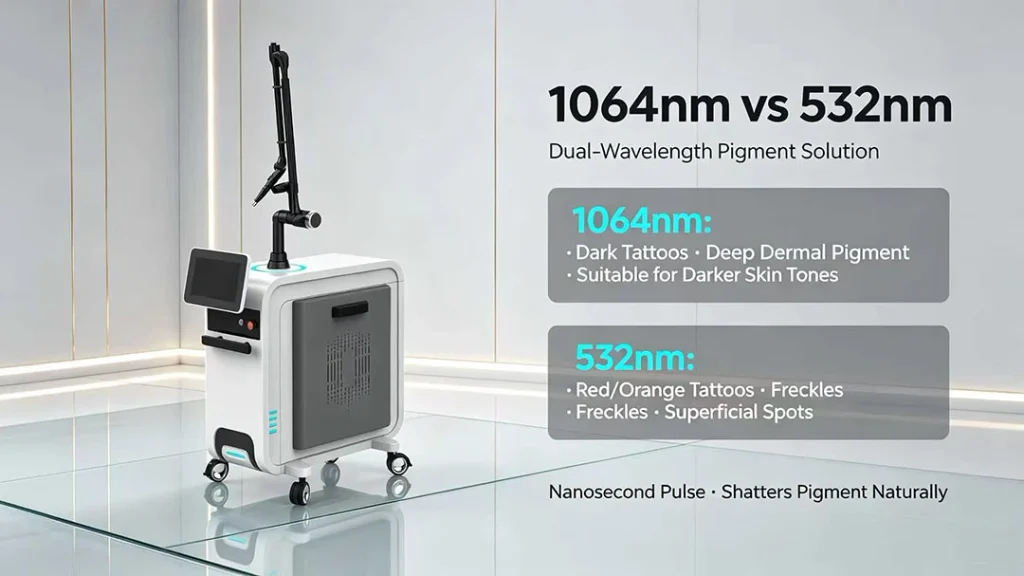
Clinics and distributors often look for one laser platform that can support more than one pigment-related service. HOMI’s Q-Switched Nd Laser Device for Pigment & Tattoo Removal uses two wavelengths: 1064 nm and 532 nm. Pulse energy reaches 2000 mJ (2 J), giving clinics more flexibility when treating different pigment targets.
Dual-Wavelength for Clinic Use
The 1064 nm wavelength is commonly used for dark tattoo pigments and deeper pigment targets. The 532 nm wavelength can be used for red-toned tattoo pigments and more superficial pigmentation.
This configuration can help a clinic expand its treatment range without adding a separate laser for each application. The device also includes an aiming beam, digital pulse counter, and integrated cooling system to support daily operation.
Custom Options for Distributors
Distributors may need more than standard equipment. They may also need branding or software that fits their local market. HOMI offers multilingual software, custom branding, training, technical support, and OEM/ODM services.
These options allow distributors to prepare the equipment for different markets. They can also support businesses that plan to sell the laser under their own brand.
Frequently Asked Questions
What is a Q-switched Nd:YAG laser primarily used for?
It is primarily used for tattoo removal and selected benign pigmented lesions. Depending on the system and applicable indications, it may also support other aesthetic procedures.
What is the difference between 1064 nm and 532 nm?
1064 nm is commonly used for black and dark tattoo pigments and deeper targets. 532 nm is commonly used for red-toned tattoo pigments and superficial pigmentation. They are complementary wavelengths.
Is a Q-switched Nd:YAG laser suitable for darker skin?
The 1064 nm wavelength is often preferred for darker skin types because it has lower epidermal melanin absorption than shorter visible wavelengths. However, treatment still requires appropriate patient assessment and parameter selection.
How many treatments are required for tattoo removal?
There is no fixed number. Treatment requirements depend on ink color and composition, tattoo depth and density, location, skin characteristics, previous treatment, and individual response.
Conclusion
Q-switched Nd:YAG technology remains widely used for tattoo removal and selected pigmentation treatments, with 1064 nm and 532 nm covering different pigment targets and treatment applications.
For clinics and medical spas, the technology offers a practical combination of established Q-switched performance and dual-wavelength capability. For distributors, factors such as configuration, documentation, customization, and technical support also determine whether a system fits the target market.
HOMI’s Q-Switched Nd:YAG Laser Device combines 1064 nm and 532 nm wavelengths with pulse energy up to 2000 mJ (2 J), together with integrated cooling, aiming-beam guidance, digital pulse counting, and B2B customization options. These features make it suitable for clinics and distributors looking for a versatile platform for tattoo and pigmentation applications.