Key Takeaways
- RF microneedling combines controlled needle insertion with radiofrequency energy delivery. When comparing machines, buyers should look at depth control, cartridge options, treatment workflow, and supplier support instead of focusing only on a maximum power or depth figure.
- Adjustable depth allows practitioners to control how far the needles enter the skin. However, the useful depth range depends on the selected handpiece, cartridge, treatment area, and operating protocol.
- Insulated and non-insulated needles deliver RF energy in different ways. Neither option is suitable for every application, so buyers should compare the needle design with the intended treatment requirements.
- Consumables, training, documentation, and maintenance can all affect long-term operating costs. These factors deserve attention before the initial purchase is finalized.
- A professional RF microneedling machine should be evaluated as a complete package, including handpieces, cartridges, safety controls, operating guidance, and supplier support.
What Is RF Microneedling?
RF microneedling is a professional aesthetic technology that combines fine needle penetration with radiofrequency (RF) energy. During treatment, the needles enter the skin to a selected depth, while RF energy is delivered through the active electrode areas of the cartridge.
This RF microneedling technique works in two ways: it creates microchannels in the skin and delivers RF energy at the same time. Microchannels are small, controlled openings created by the needles as they enter the skin. Standard microneedling creates these microchannels without RF energy, while surface RF treatment delivers RF energy on the skin surface without using needles to penetrate the skin.
The Core Technology Behind RF Microneedling
Needle Penetration and Energy Delivery
During an RF microneedling treatment, the cartridge inserts fine needles into the skin. The active electrode areas then deliver RF energy at the selected depth.
When RF energy passes into tissue, some of that energy is converted into heat. This produces the thermal effect. The amount and distribution of this heat depend on several factors, including needle design, insertion depth, RF settings, contact with the skin, tissue characteristics, and the way the device delivers RF energy.
The maximum depth describes how far the needles can physically be inserted when that particular configuration is used. It does not mean that the deepest setting is suitable for every treatment area or every patient.
Why Depth Control Matters
Depth control allows practitioners to adjust how far the needles enter the skin. Since different treatment areas may require different depths, having several depth options can give a clinic greater flexibility.
When comparing machines, buyers should check how the depth is adjusted and how clearly the selected depth is displayed. They should also confirm whether every cartridge supports the same range. A machine may advertise a wide overall depth range, while individual needle heads cover only part of that range.
Needle Count and Coverage
Many RF microneedling cartridges contain multiple needles arranged in a specific pattern. This arrangement is often called a needle array. The number of needles in the array affects the area covered by each application and the spacing of the treatment pattern.
A cartridge with more pins may cover a larger area, while one with fewer pins may be more suitable for smaller or more targeted areas.
Pin count, however, does not tell buyers everything they need to know. The needle type, depth range, insulation design, RF mode, and intended application should also be considered.
Before purchasing, buyers should identify:
- Available pin counts and their intended treatment areas
- Needle diameter and spacing, where disclosed
- Whether each cartridge is sterile and single-use
- Compatible handpieces and software
- Replacement costs and the ordering process
What Should Buyers Compare Before Procurement?
Insulated and Non-Insulated Needle Designs
An Insulated RF Microneedle has a coated section along the needle shaft, leaving a defined electrode area exposed. The needle shaft is the main body of the needle that enters the skin. With an insulated design, the coating prevents RF energy from being delivered along the covered part of the shaft, so energy is concentrated around the exposed electrode section.
A non-insulated needle has a larger conductive area along the needle shaft. In this context, conductive means that the material allows electrical energy to pass through it. As a result, RF energy can be delivered along a larger portion of the insertion path, depending on the cartridge design and selected settings.
Neither design should be selected based on the name alone. Buyers should ask about the exposed electrode length, available depth range, compatible handpieces, and recommended treatment settings. Once the machine is in use, practitioners should follow the device-specific protocol rather than applying settings from another platform.
| Evaluation Point | Insulated Needle | Non-Insulated Needle |
| RF delivery pattern | More localized around the exposed electrode section | More distributed along the exposed conductive needle surface |
| Main consideration | Place the active electrode at the intended depth | Consider RF delivery along the conductive section of the needle |
| Procurement question | What is the exposed electrode length? | How much of the needle shaft is conductive? |
| Compatibility check | Which cartridges, depths, and handpieces are compatible? | Which cartridges, settings, and treatment areas are supported? |
| Safety consideration | Insulation limits RF delivery along the coated section but does not eliminate treatment risks | Needle depth, RF energy, treatment technique, and treatment pattern must all be controlled |
Evaluating RF Frequency and Energy Modes
RF frequency is another specification worth checking. Frequency describes how many times the electrical signal cycles per second and is expressed in units such as kilohertz (kHz) or megahertz (MHz). In an RF microneedling machine, different frequencies may be assigned to different needle series or cartridges.
Some machines use more than one RF frequency. Dual-Frequency RF Microneedling can give clinics more configuration options when each frequency is matched with a defined cartridge and operating protocol. Before purchasing, buyers should ask which handpieces use each frequency and whether the manufacturer provides clear operating instructions for each option.
It is also worth checking how the machine delivers RF energy at different depths. Some devices can deliver RF energy sequentially, meaning the energy is delivered at several selected depths in a defined order during one treatment cycle. When this feature is available, buyers should check which cartridges support it and how the selected depths are configured.
Vacuum Assistance and Skin Contact
Stable contact between the treatment head and the skin can help practitioners maintain consistent needle placement. Suction-Assisted RF Microneedling uses vacuum support to help hold the skin against the treatment head during operation.
When evaluating this feature, buyers should check which cartridges support vacuum operation and whether the vacuum level can be adjusted. They should also confirm the cleaning requirements and operator training before purchase.
Vacuum assistance can help maintain consistent contact during treatment, but it does not replace proper technique. Practitioners should use the feature according to the machine’s operating instructions.
A B2B Checklist for Comparing RF Microneedling Machines
Before requesting quotations, prepare a comparison sheet that covers the equipment, consumables, and ongoing support. So their availability and replacement cost can affect the machine’s long-term operating cost.
- Confirm the RF frequency or frequencies and identify which cartridge series use each one.
- Request the complete list of needle heads, pin counts, insulation options, and depth ranges.
- Check whether the stated depth range applies to all cartridges or only specific heads.
- Confirm sterile packaging, single-use status, and compatibility requirements for replacement cartridges.
- Review the operator interface, emergency-stop function, maintenance requirements, and error-reporting process
- Clarify what training is included and whether updated operating materials are available.
- Ask how replacement cartridges, spare parts, and technical service are handled in the destination market.
- Confirm the documentation required for local registration, import, insurance, and clinical operation.
- Compare the expected cost of consumables and service with the initial machine price.
HM-MF-01 Configuration for Clinics Seeking Broad Cartridge Flexibility
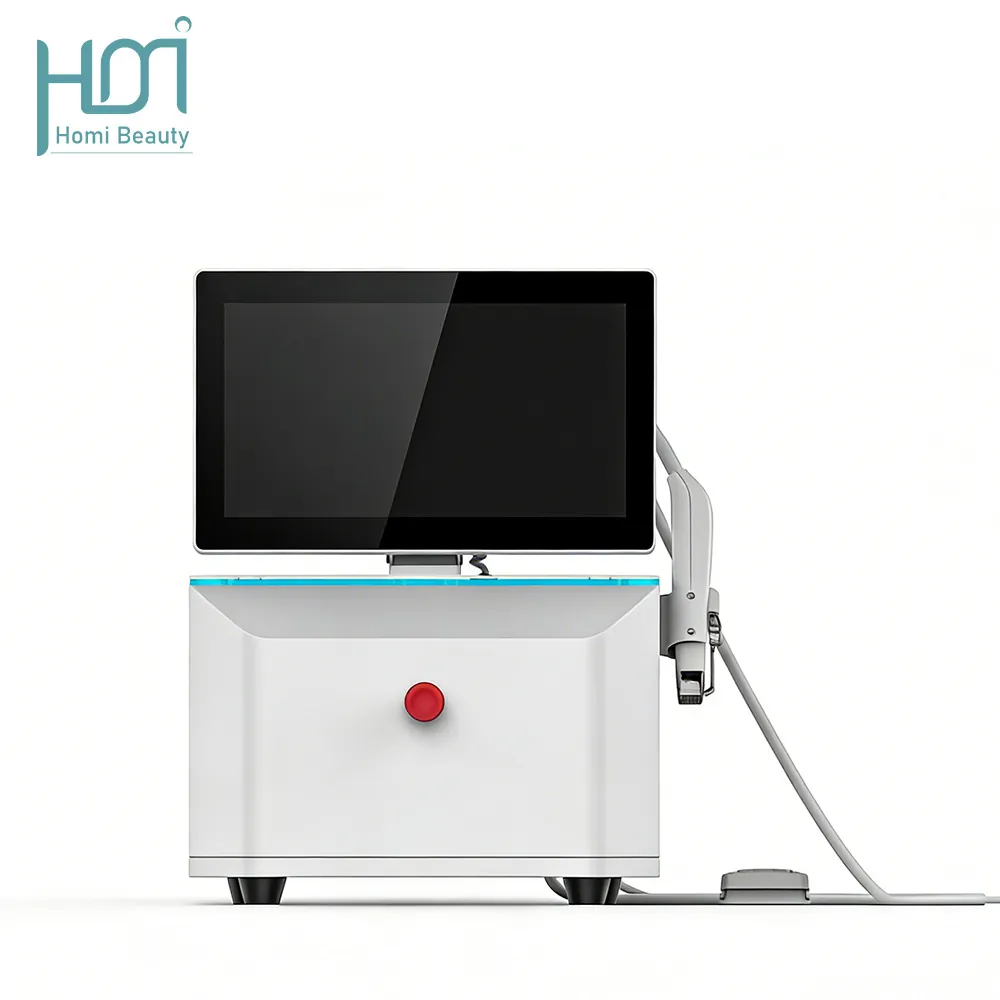
For clinics and distributors looking for a configurable RF microneedling platform, the HM-MF-01 Golden Microneedling RF & Fractional RF Machine combines multiple needle configurations, adjustable working depths, and different RF delivery options. The product is designed with interchangeable working heads, allowing the configuration to be adjusted according to the treatment area and intended application.
Multiple Working Heads and Needle Configurations
The HM-MF-01 comes with 13 working heads across four series. The pink NV series includes NV64, NV49, NV36, and NV9 heads. The apricot yellow IS series includes IS49, IS25, and IS5, while the green IC series includes IC40, IC24, and IC12. The light purple series includes HR1, HR2, and HR3 heads for non-invasive thermal treatment.
The microneedling heads provide different pin configurations, including 64, 49, 40, 36, 25, 24, 12, 9, and 5 pins. This range gives clinics more options when matching the treatment head to the required coverage and treatment area.
Adjustable Depth and Multi-Layer Energy Delivery
The HM-MF-01 provides a working depth range of 0.2–7 mm, depending on the selected head. The NV and IS series support depths up to 4.5 mm, while the IC series can reach up to 7 mm.
Selected heads also support 1–5 layer sequential output. This means RF energy can be delivered at several preset depths in sequence during one treatment cycle. The feature allows the operator to work at different depths without changing the working head between each selected layer.
Two RF Frequencies and Vacuum-Assisted Operation
The machine uses two RF frequencies: 700 kHz for the IS and IC needle arrays and 2.2 MHz for the NV needle arrays. It also combines suction-assisted and non-suction modes. The suction-assisted configuration uses vacuum to help stabilize the position between the treatment head and the skin during operation.
These options give buyers more configuration flexibility when comparing needle type, RF frequency, depth, and treatment method. The appropriate combination still depends on the selected working head and the manufacturer’s operating instructions.
CRS Consumables Management
The HM-MF-01 also includes a CRS Consumables Management System. The system can control the use of consumables through code scanning and can also manage working-head usage time.
For distributors and clinics, this adds a consumables management function to the machine itself. Buyers should still confirm how the coding process works, which working heads are covered, and how replacement consumables are supplied in their market.
Before finalizing a purchase, buyers should request the latest product specifications, standard packing list, compatible consumable list, user documentation, training scope, warranty terms, and market-specific compliance materials.
Frequently Asked Questions
What should a clinic compare first when buying an RF microneedling machine?
Start with the available cartridge range, depth control, needle insulation options, RF modes, consumable availability, and supplier support. A machine’s maximum depth or headline feature should not replace a full review of its available configurations.
Are insulated needles always the better choice?
No. Insulated and non-insulated needles deliver RF energy in different ways. The appropriate option depends on the device configuration, treatment area, treatment objective, patient assessment, and operator training.
Why are consumables important in RF microneedling procurement?
Cartridges affect treatment workflow, hygiene management, operating costs, and service continuity. Before purchasing a machine, clinics should check cartridge compatibility, packaging, ordering lead times, replacement costs, and long-term availability.
Can one RF microneedling machine be used for facial and body procedures?
Some machines provide different cartridge types and depth ranges for different treatment areas. Buyers should verify which handpieces and protocols are intended for facial or body use rather than assuming that the machine’s maximum depth applies to every procedure.
Does a higher pin count mean a better RF microneedling treatment?
Not necessarily. Pin count mainly affects coverage and the treatment pattern. Buyers should consider it together with needle type, depth range, electrode design, treatment area, and the device-specific protocol.
Conclusion
Choosing an RF microneedling machine requires more than checking its maximum depth or RF output. Buyers should look at the needle design, depth options, RF delivery, cartridge range, consumables, and supplier support to see whether they match the clinic’s intended use.
A detailed review before purchase can also help clinics avoid problems with incompatible cartridges, unclear operating requirements, or ongoing consumable supply.
For detailed HM-MF-01 specifications, cartridge configurations, and quotation support, contact HOMI Laser.