Introduction
Choosing an RF platform is not always straightforward for an aesthetic clinic. Two machines may both be marketed for skin tightening, wrinkle improvement, and skin rejuvenation, yet the way they deliver RF energy can lead to very different treatment approaches.
Microneedling RF and Non-Invasive RF illustrate this difference clearly. Microneedling RF uses fine needles to deliver RF energy at selected depths within the skin, while non-invasive RF delivers energy through a surface applicator without needle penetration. These different approaches can affect treatment depth, treatment flexibility, patient experience, and clinical workflow.
Which technology is better for your clinic? The right choice depends on the treatments you plan to offer, the level of treatment control you need, patient preferences, and how the technology fits into your existing equipment and daily operations. This comparison will look at the practical differences between microneedling RF and non-invasive RF to help clinics make a more informed equipment decision.
What Is Microneedling RF?
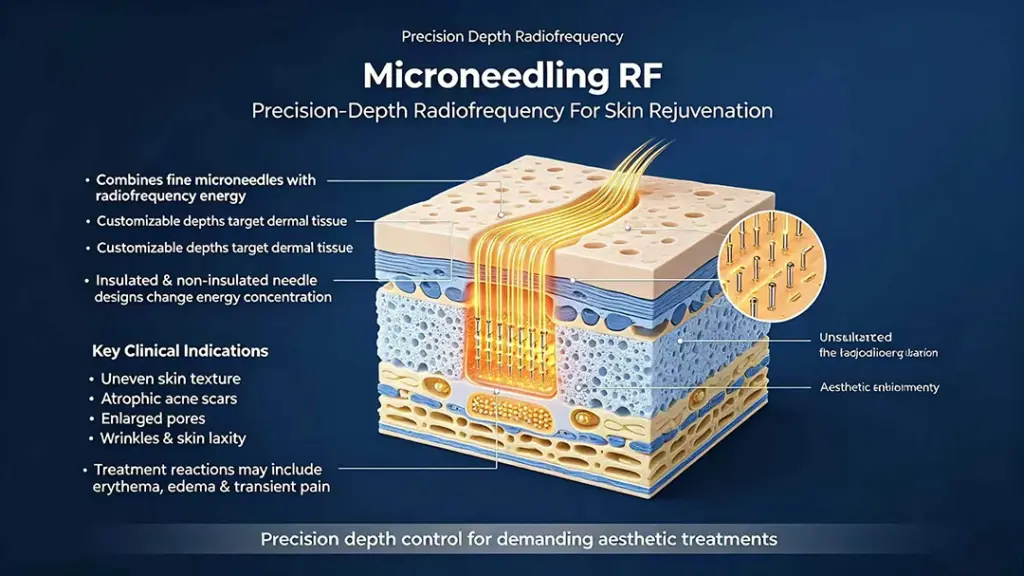
Microneedling RF is a technology that combines microneedles with radiofrequency (RF) energy. Fine needles penetrate the skin to a selected depth, where RF energy heats the surrounding tissue. This allows practitioners to deliver RF energy at specific tissue depths.
How the RF energy is distributed depends on the design of the needle electrodes. Some needle designs allow RF energy to be delivered along more of the needle, while insulated needles mainly deliver energy through their exposed electrode portions. As a result, different needle designs can change where RF energy is concentrated within the tissue.
In aesthetic practice, microneedling RF is commonly used to address concerns such as uneven skin texture, acne scars, wrinkles, and skin laxity. The appropriate treatment approach depends on factors such as the treatment area, needle configuration, energy settings, device design, and individual patient needs.
What Is Non-Invasive RF?
Non-Invasive RF is an RF treatment that works without inserting needles into the skin. Instead, a handpiece is applied directly to the skin, making it a needle-free option for clinics and patients who prefer a non-penetrating treatment approach.
Unlike microneedling RF, non-invasive RF does not rely on needle depth or electrode placement within the skin. Its treatment characteristics are mainly determined by the RF system, handpiece design, and selected treatment settings. Monopolar, bipolar, and multipolar systems, for example, use different electrode configurations and can deliver RF energy in different ways.
In aesthetic practice, non-invasive RF is commonly used for treatments focused on skin tightening, wrinkle improvement, and, with some devices, body contouring. Because the treatment does not involve needle insertion, it can also fit well into clinics that prioritize a simpler, needle-free treatment experience.
Microneedling RF vs Non-Invasive RF: Key Differences
Although both technologies rely on RF-induced heating, their treatment approaches are fundamentally different. Understanding these differences is more useful than simply asking which technology is “stronger.”
Treatment Method and Skin Contact
Microneedling RF uses needle penetration to position electrodes within the skin. Non-invasive RF uses an external applicator placed on the skin surface.
This distinction directly affects the treatment experience and the type of energy-delivery strategy available. For a clinic, this means the two technologies may serve different roles rather than being direct substitutes.
Treatment Depth and Energy Delivery
Treatment depth is one of the clearest technical differences.
With microneedling RF, the practitioner can often select a needle penetration depth before RF delivery. This makes it possible to position RF electrodes within a defined tissue layer. With non-invasive RF, energy must pass through the skin surface before producing its thermal effect in tissue, and the effective penetration pattern depends on the RF configuration and device design.
This is why depth control can be important when comparing RF systems. A device with multiple depth settings may provide more treatment flexibility than a fixed-depth system, but greater depth does not automatically mean better results. The appropriate depth must correspond to the treatment area, indication, patient characteristics, and device protocol.
Treatment Versatility and Customization
A basic non-invasive RF system may offer a relatively straightforward workflow, while a more advanced microneedling RF platform may provide multiple needle arrays, insulation patterns, treatment depths, and energy settings.
That additional flexibility can be useful for clinics serving a broad range of aesthetic concerns. However, it can also increase the need for operator training and parameter selection.
A useful comparison therefore goes beyond the number of settings. Clinics should consider whether those settings provide practical advantages in daily treatment rather than simply increasing technical complexity.
Skin Irritation and Downtime Considerations
The two technologies also differ in how they interact with the skin.
Non-invasive RF does not require needle insertion, so it avoids the mechanical micro-injury associated with microneedling. This can make it attractive for patients who prefer a non-penetrating treatment approach.
Microneedling RF, by contrast, intentionally combines needle penetration with RF energy delivery. Temporary redness, swelling, discomfort, or other short-term reactions may occur depending on the treatment parameters and individual patient response. Recent reviews describe erythema, edema, and transient pain among the commonly reported temporary effects of RF microneedling.
For this reason, clinics should communicate realistic recovery expectations rather than assuming that all RF treatments have identical downtime.
Which Technology Is Better for Different Skin Concerns?
The better option depends on the treatment objective, patient profile, and how each device fits into the clinic’s daily workflow. Below is a practical breakdown by common indications.
Acne Scars and Enlarged Pores
Microneedling RF is often considered when the treatment plan requires controlled delivery of energy at specific depths and when skin texture is a major concern. Clinical research has reported improvements in atrophic acne scar scores following RF microneedling, although outcomes vary by treatment protocol and device.
Non-invasive RF can still play a role in an overall skin-rejuvenation strategy, particularly where the treatment goal is centered more on tightening and thermal skin conditioning than on needle-based resurfacing.
Clinic takeaway: For acne scars and deep textural concerns, microneedling RF is usually the more targeted option. Non-invasive RF may be a complementary choice when the main goal is general skin tightening rather than scar revision.
Skin Laxity and Fine Lines
Both RF approaches can be relevant to skin laxity and fine lines because RF-induced heating has been associated with dermal remodeling and changes in collagen structure.
Non-invasive RF may be attractive when a clinic prioritizes a needle-free, lower-preparation workflow. Microneedling RF can provide additional flexibility when the practitioner wants to combine controlled needle penetration with RF delivery.
Clinic takeaway: If the primary goal is mild-to-moderate skin laxity and patients prefer no downtime, non-invasive RF may be the first choice. If the clinician wants to address laxity together with textural issues, microneedling RF may offer broader utility.
Uneven Skin Texture and Other Body Applications
Microneedling RF may be considered when skin texture and targeted tissue treatment are central to the treatment plan. Non-invasive RF is also used in aesthetic applications involving skin tightening and body contouring.
For body applications, however, clinics should pay particular attention to the intended treatment area and device-specific indications. A machine designed primarily for facial treatments should not automatically be assumed to provide the same performance or intended use across all body areas.
Clinic takeaway: For facial textural concerns, microneedling RF is often the more focused option. For body contouring or larger-area skin tightening, non-invasive RF systems with the appropriate handpieces and indications may be more practical.
Can One RF Machine Combine Both Technologies?
Some RF platforms are designed to combine microneedling RF and non-invasive RF within a single system. However, not all multi-mode machines offer the same level of treatment flexibility. For clinics considering a combined RF platform, the key consideration is whether having both technologies in one system provides practical value for daily treatment workflows.
The Benefits of Multi-Mode RF Technology
A multi-mode RF platform can support different treatment workflows within the same equipment ecosystem. For a clinic, this can reduce the need to purchase, maintain, and train staff on separate platforms for needle-based RF and surface-applied RF. It may also make it easier to offer patients a wider range of treatment options without referring them elsewhere.
However, the actual benefit depends on whether the machine’s handpieces, depth settings, energy modes, and workflow are genuinely useful for the clinic’s patient base. A machine that offers both technologies but requires complex setup changes between treatments may not improve daily efficiency.
How Adjustable Depth and Layered Energy Delivery Improve Treatment Flexibility
Adjustable depth gives practitioners greater control over where RF energy is delivered when using a needle-based system. Instead of treating at a single fixed depth, the operator can adjust the needle penetration according to the treatment area and clinical goal.
Layered energy delivery takes this a step further. Some microneedling RF systems can deliver RF energy at different selected tissue depths during the same treatment cycle. This may allow practitioners to address multiple tissue layers without relying on a single fixed treatment depth. These configurations can be supported through different Layered RF Microneedle Probes depending on the system design.
In practice, this means the provider is not locked into a single treatment depth or energy pattern. Depending on the patient and the area being treated, the protocol can be adjusted to target different tissue layers. The practical advantage is not simply “deeper is better.” Instead, different depths and energy patterns provide more options for tailoring a protocol to the treatment area and objective.
How to Choose the Right RF Technology for Your Aesthetic Clinic?
Choosing the right RF technology starts with the clinic’s treatment goals rather than the machine’s specification sheet. The decision should take into account the procedures the clinic wants to offer, the level of treatment flexibility required, and the practical demands of operating and maintaining the equipment.
Match the Technology to Your Treatment Portfolio
The first question is what treatments the clinic actually needs to provide. A clinic focused on needle-free skin tightening may find non-invasive RF more suitable for its existing services. A clinic that wants to offer treatments involving controlled RF delivery at selected depths may benefit more from a microneedling RF platform.
For clinics looking for broader RF capabilities, a multi-mode platform can combine different treatment approaches within one system. The right choice should complement the clinic’s existing equipment and fill a genuine gap in its treatment portfolio.
Look at the Level of Treatment Control You Need
The next step is to evaluate how much control the clinic needs over treatment parameters. Depending on the device, this may include adjustable treatment depth, RF frequency, needle configuration, insulated or non-insulated electrode designs, and different treatment heads.
More treatment options can provide greater flexibility, but they also require operators to understand how and when to use those settings. The goal is not to choose the machine with the most parameters, but to choose a platform whose treatment controls are relevant to the procedures the clinic performs.
Evaluate the Practical Cost of Running the Device
The final decision should also account for what happens after the machine is installed. Clinics should understand how treatment heads and other consumables are managed, how usage is tracked, how replacements are handled, and whether the system includes consumables-management functions.
These operational details can affect both workflow and long-term costs, especially in clinics with frequent treatments. A technically capable machine may not be the best fit if its consumables or daily operating process are difficult to manage.
A Multi-Mode RF Solution for Clinics: HM-MF-01 Golden Microneedling RF & Fractional RF Machine
The HM-MF-01 is a multi-functional RF Microneedling Machine designed around multiple RF treatment modes, interchangeable treatment heads, adjustable treatment depths, and both needle-based and non-invasive treatment functions.
Rather than offering only one fixed RF configuration, the system integrates Suction-Assisted RF Microneedling, non-suction modes, different needle array configurations, insulated and non-insulated needle bodies, layered energy delivery, and energy-activated treatment heads within one platform.
Dual-Frequency RF and Multiple Treatment Heads
The HM-MF-01 uses a Dual-Frequency RF Microneedling configuration with two RF frequency settings:
l 700 kHz for the IS and IC series needle arrays
l 2.2 MHz for the NV series needle arrays
The system comes with 13 working heads across four treatment-head configurations. This range allows the operator to select different needle arrays and treatment configurations according to the treatment setup.
| Head Configuration | Series | Needle / Electrode Design | Needle Diameter | Needle Spacing | Working Depth | Key Feature |
| Pink | NV64, NV49, NV36, NV9 | Non-insulated needle bodies | 0.2 mm | 1.5 mm | 0.2–4.5 mm | Suction-assisted technology |
| Apricot Yellow | IS49, IS25, IS5 | Insulated needle bodies with exposed electrode tips | 0.2 mm | 1.5 mm | 0.2–4.5 mm | Sequential energy output at different depths |
| Green | IC40, IC24, IC12 | Insulated needle bodies with exposed electrode tips | 2.5 mm | 1.5 mm | 0.2–7 mm | Automatic output across 1–5 layers |
| Light Purple | HR1, HR2, HR3 | Flat electrodes | — | — | — | Non-invasive thermal treatment |
Adjustable Treatment Depth from 0.2 to 7 mm
One of the defining specifications of the HM-MF-01 is its adjustable treatment depth.
The system supports insulated-head penetration settings from 0.2 to 7 mm, allowing the operator to select different target tissue depths according to the treatment setup.
The green IC series extends to a maximum working depth of 7 mm and can automatically output energy across 1–5 layers. The yellow IS series also supports sequential energy output at different depths, allowing treatment areas to be adjusted through layered energy delivery.
This design gives the HM-MF-01 a broader range of depth configurations than a fixed-depth RF microneedling platform.
Microneedling and Non-Invasive Thermal Treatment in One Platform
The HM-MF-01 combines needle-based RF configurations with a non-invasive thermal treatment option.
Its NV, IS, and IC series heads are designed for RF treatment using different needle structures and configurations, while the HR series uses flat electrodes for non-invasive thermal treatment.
The platform also incorporates suction-assisted and non-suction treatment modes, giving operators additional configuration options within the same system.
For clinics that want one platform to cover multiple RF treatment approaches, this combination can simplify equipment selection while expanding treatment flexibility. The device also includes a CRS consumables management system designed to control consumable use through code scanning and usage management.
Conclusion
Microneedling RF and non-invasive RF offer different approaches to RF-based aesthetic treatments, and the right choice depends on the treatment needs and workflow of each clinic. The HM-MF-01 combines both approaches with dual RF frequencies, interchangeable treatment heads, adjustable depths from 0.2 to 7 mm, layered energy delivery, suction-assisted treatment, and non-invasive thermal treatment in one platform.
For aesthetic clinics considering a multi-mode RF solution, evaluating these features against their actual treatment requirements can help determine whether the HM-MF-01 is a suitable fit. If you are looking for a versatile RF platform for different aesthetic treatment needs, contact us to learn more about the HM-MF-01 and its available configurations.