Key Takeaways
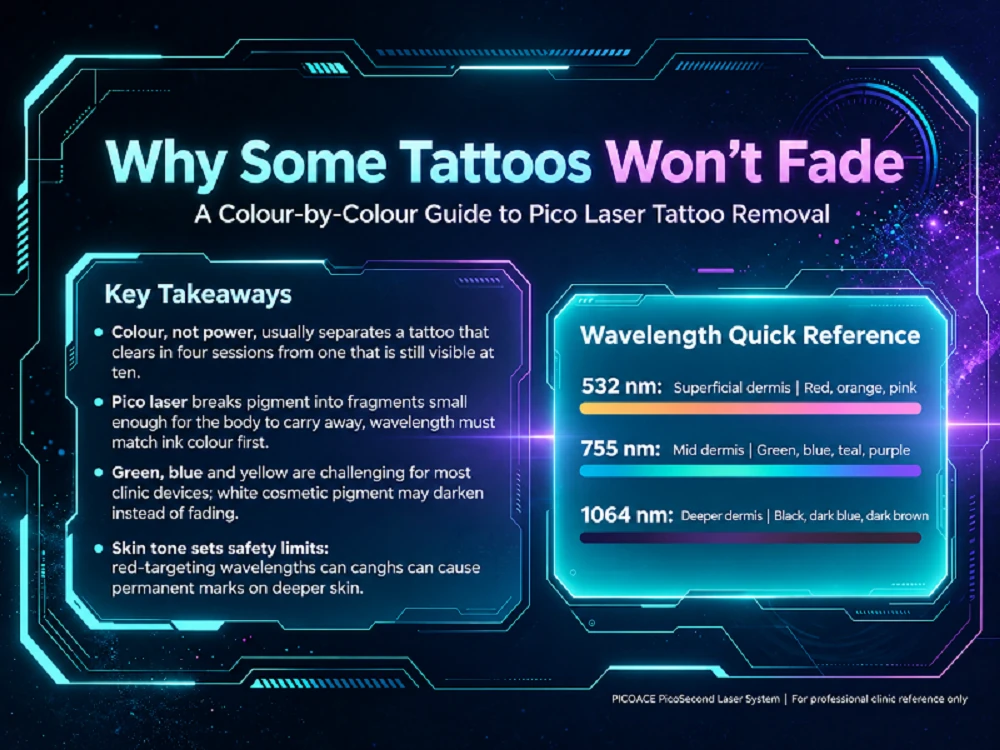
- Colour, not power, usually separates a tattoo that clears in four sessions from one that is still visible at ten.
- Pico Laser Tattoo Removal breaks pigment into fragments small enough for the body to carry away, so the wavelength has to match the ink before any other setting matters.
- Green, blue and yellow sit furthest from the wavelengths most clinics own, and white or cosmetic pigment can darken instead of fading.
- Skin tone sets the safe limit: the wavelength that clears red quickly can leave a permanent mark on deeper skin.
What a Laser Actually Does to Tattoo Ink
Tattoo ink does not sit on the surface. An artist drives pigment through the epidermis into the dermis, where the particles are too large for the body to break down, so immune cells gather around them and stay. A laser works at that particle level: light of a chosen wavelength is absorbed by the pigment rather than by the water and collagen around it, and the energy fractures each particle into smaller pieces. Once those pieces are small enough, the lymphatic system carries them away over the following weeks. Fading therefore appears between sessions, not during them.
Two mechanisms do the fracturing. Longer pulses work by heat, which spreads into surrounding tissue. Shorter pulses work by pressure, because energy arrives so fast that pigment shatters before heat can travel. A Picosecond Laser fires in units of one trillionth of a second, short enough for that pressure effect to dominate, which means finer debris and less heat in the surrounding skin.
Why Ink Colour Decides the Result
Colours are not equally difficult, and the gap is not subtle. Each pigment absorbs some wavelengths and reflects others, so energy at a wavelength the ink reflects is wasted at best; at worst it lands in the surrounding melanin, which is where burns, blistering and patchy lightening begin. This is why two clinics quoting Pico Laser Tattoo Removal at similar prices can produce very different results.
Matching Wavelength to Pigment
Four wavelengths do most of the work, and each owns a different part of the colour wheel.
| Wavelength | Reaches | Ink colours it suits | Note on skin tone |
| 532 nm | Superficial dermis | Red, orange, pink, some yellow | Strongly absorbed by melanin; use with care on Fitzpatrick IV–VI |
| 694 nm (ruby) | Mid dermis | Green, some blue | High melanin absorption, close to 532 nm; also rare on multi-wavelength platforms |
| 755 nm | Upper to mid dermis | Green, blue, teal, purple | Lower than 532 nm but still significant; check the skin first on Fitzpatrick V–VI |
| 1064 nm | Deeper dermis | Black, dark blue, dark brown | Lowest melanin absorption; the safer starting point on deeper skin |
The table is a starting map, not a prescription. Inks are mixtures rather than standardised substances, so two tattoos that both look green can behave differently.
The Colours That Decide the Difficulty
Green and blue are the first real test of a platform. A green pigment reflects much of the light a 532 nm handpiece delivers, while 1064 nm passes through it almost untouched, which leaves 755 nm or, where available, 694 nm ruby. A clinic limited to 1064 and 532 can be technically excellent and still fail on green, which is the most common reason a client is told the tattoo cannot be removed.
Yellow is the colour that requires the most careful expectation setting. No wavelength in routine use absorbs it strongly, including 532 nm, which offers the best chance without a guarantee. Many green pigments carry a yellow undertone too, so a leaf may clear to a faint yellow residue that does not fully resolve. Explaining this before the first session sets a realistic endpoint and avoids a dispute later in the course.
White, flesh-toned and cosmetic pigment behave differently again. Many contain titanium dioxide or zinc oxide, which can oxidise under laser light and turn grey or black in a single pass. A cosmetic brow that darkens after one session is responding to that oxidation, not to a machine fault. A small test area, observed for a few weeks, is the only reliable way to learn which way a pigment will go; when it darkens and stays dark, stopping is often the better decision.
Red and orange respond well to 532 nm, and that is the difficulty: the wavelength melanin absorbs most strongly is the one warm colours need, so the margin between an effective pass and an epidermal injury narrows on deeper skin. Red pigment also carries a higher chance of an allergic reaction, which makes a history question worth asking.
Skin Tone Changes the Plan, Not Just the Setting
Two clients with the same black design and different Fitzpatrick types are not the same case, even though the ink is identical. What differs is how much competition the light meets on its way to the pigment.
Melanin as a Competing Absorber
Melanin absorbs across the visible and near-infrared range, and far more readily at shorter wavelengths. On Fitzpatrick IV–VI skin, that competition is the central constraint. A 532 nm pass that is routine on fair skin may need to be shortened or skipped, because the epidermis takes the energy before it reaches the ink. For 1064nm Tattoo Removal, light travels deeper with far less surface uptake, which is why black and dark blue ink on deeper skin is the most predictable combination in the field.
Working Safely on Fitzpatrick IV–VI Skin
Safety on these skin types depends on sequencing rather than on intensity. A test spot on a less visible area comes first, fluence stays conservative for the opening pass, and intervals stretch rather than shrink. Cooling requires more attention, not less. Sun exposure in the fortnight before a session is a reason to reschedule, since tanned skin behaves like a darker skin type. The main risk to guard against is hypopigmentation, a loss of pigment that can be permanent; hyperpigmentation usually settles with time, a white patch does not.
When Colour Is Only Half the Story
The same colour and the same machine regularly produce different results. Colour explains most of the variance, not all of it, and these factors account for the rest:
- Ink load. A solid black panel holds far more pigment per square centimetre than fine line work, and every layer has to be reached.
- Depth and evenness. Professional work packs more ink layers, more densely and more evenly, than amateur work, which changes the energy required.
- Age. Older tattoos have already been partly broken down, so they often fade faster than fresh, saturated ones.
- Layering and cover-ups. Where a second design sits over an earlier one, two pigment layers have to break down at once, and the mixed colours rarely share one wavelength.
- Location. Hands, feet and ankles clear more slowly than the torso, because circulation is poorer there.
- Scar tissue. Fibrosis from the tattoo or from earlier aggressive sessions scatters light and makes the response patchy.
Telling a Stalled Case from a Slow One
Most disappointment comes from judging too early. Frosting, redness and mild swelling say nothing about whether a session worked; the visible change is judged six to eight weeks later, once debris has been carried away. A tattoo unchanged at two weeks may still be responding.
A genuine stall looks different: no visible change across two full intervals, one colour frozen while the others fade, results that are patchy rather than evenly light, or skin reactions severe enough to force the energy down at every visit. The productive response is to change the approach rather than the settings: wavelength against pigment, depth, spot size, and an interval that allows clearance rather than mere healing. More energy at a wavelength the pigment reflects adds heat, not lightening.
Planning a Multi-Colour Tattoo, Session by Session
A multicolour piece is several small jobs sharing one patch of skin, and the sequence between them decides how it goes.
Map the Pigments Before the First Pulse
The first appointment is mostly assessment. Photograph the tattoo in consistent light, list every colour present, note the undertones, and record whether any area has been treated before. Then decide, colour by colour, which wavelength goes first. Starting with the most difficult colour is often the better choice, because its response indicates more about the likely course than anything the client can describe.
Spacing, Endpoints and Photo Records
Six to eight weeks between sessions is a working norm, and the waiting is for clearance rather than healing. The endpoint within a session is light frosting with mild redness, not blanching, blistering or a grey crust. Photographs shot from the same distance, angle and light source at each visit settle most disputes about progress, including disagreements between a client’s recollection and the photographic record. Any picosecond tattoo removal machine can only work within these limits: the treatment plan determines the outcome, and the equipment either supports that plan or constrains it.
What the Machine Has to Deliver
Once the plan is settled, the equipment requirements become short and specific.
Wavelength Coverage Comes First
The first question is not how much energy a platform produces, but which wavelengths it offers. A two-wavelength machine covers black and warm colours, which is a large share of typical bookings, but it will not solve green. That is not a training problem, and no setting compensates for it. If mixed ink is a real part of the case mix, 755 nm stops being an optional extra.
Beam Shape and Spot Size Decide the Detail
Beam profile is often the least examined parameter at purchase, and it determines where treatment goes wrong. A Gaussian beam concentrates energy at its centre, so the middle of each spot is treated harder than the edge, and that hot centre is where pinpoint burns and post-inflammatory marks begin. A flat-top beam spreads energy evenly across the whole spot, which makes the delivered dose predictable.
Spot size matters just as much. Eyeliner, brow correction and small lettering need a small spot; large panels need a wide one to keep appointment times reasonable, and the range has to stay usable at both ends.
Three Wavelengths in One Console: Inside PICOACE
PICOACE was built around the case mix described above: mixed pigments, deeper skin types, and a clinic that prefers keeping a difficult booking to referring it out. Three wavelengths and an even beam sit in one console.
1064 nm, 532 nm and Optional 755 nm
The 1064nm 532nm 755nm Picosecond Laser Machine configuration covers the three groups that decide most outcomes: black and dark blue at 1064 nm, red, orange and pink at 532 nm, and the green-blue family at 755 nm. The third wavelength is offered as an option rather than forced into every order, so a clinic can add the coverage when bookings justify it. Because the wavelength is chosen by ink colour rather than by platform, a sleeve with black outlines, red detail and green fill can be planned as one course instead of three referrals.
Flat-Top Beam, 1–10 mm Spot, 2000 mJ
The beam is flat-top, so energy stays even across the spot instead of peaking in the middle. Spot size runs from 1 mm to 10 mm on the same arm, covering eyeliner and fine lettering at one end and large panels at the other. Maximum output energy reaches 2000 mJ at the largest spot size, with a repetition rate of 1 to 10 Hz, and the seven-joint articulated arm holds spot shape at awkward angles such as the inner wrist.
Cooling and Comfort Across Back-to-Back Sessions
Cooling combines sapphire contact cooling with water and air, monitored in real time. It serves two purposes: comfort during the pass, and protection of the epidermis on darker skin, where the surface absorbs more energy than the target does. On a full clinic day, stable cooling is what allows back-to-back appointments.
Beyond Ink: Pigmentation and Uneven Tone
The same platform handles freckles, sun spots, naevus of Ota, post-acne discolouration and uneven tone. For a clinic, that breadth keeps the machine in use between tattoo bookings, and it is often the reason a second treatment room can be justified.
| Technical data | PICOACE |
| Laser type | 1064 nm and 532 nm picosecond; 755 nm optional |
| Maximum output energy | 2000 mJ (at maximum spot size) |
| Pulse duration | 2000 ps |
| Repetition rate | 1–10 Hz |
| Spot size | 1–10 mm |
| Beam profile | Flat-top |
| Delivery | Seven-joint articulated arm, transmission above 95% |
| Cooling | Sapphire TEC, water and air cooling, real-time monitoring |
| Aiming beam | 650–670 nm |
| Power supply | AC 220 V / 110 V, 50–60 Hz |
Frequently Asked Questions
Why does green ink take longer to fade than black ink?
Black pigment absorbs across a wide band, including 1064 nm, which also reaches most tattoos. Green reflects much of that light and responds mainly to 755 nm or 694 nm, so without those wavelengths sessions can continue while the visible result changes very little.
Why did a cosmetic tattoo turn darker after the first session?
Titanium dioxide and zinc oxide are common in white and flesh-toned cosmetic pigment, and laser light can oxidise them. The shift shows within days of the first pass, which is why a small patch is treated and watched before a whole brow is attempted. Where that patch stays dark, further passes rarely improve it.
How many sessions should a multi-colour tattoo expect?
No single figure applies to every case. Black line work might need four to six sessions, while dense colour and cover-ups commonly need eight or more, and each colour inside one design progresses at its own rate. Age, depth and skin type all move the estimate.
Does darker skin mean more sessions, or a different plan?
Usually both, and the plan changes first. Melanin competes for the shorter wavelengths, so treatment leans on 1064 nm, conservative fluence and longer intervals. Lower fluence also fragments less ink per pass, so the course usually runs longer than it would on fair skin. That trade is worth making, because the risk of pigment change stays lower.
Is 755 nm worth adding if most tattoos are black?
It depends on how much colour work you currently decline or refer out. If green or blue appears even occasionally, the wavelength turns a referral into a booking. If nearly every case is black and grey, 1064 nm carries the load and 755 nm can wait.
Conclusion
Colour determines most of the outcome before any energy setting is adjusted. Black responds because 1064 nm reaches it cleanly; red responds because 532 nm is absorbed strongly, more safely on fair skin than on deep skin; green and blue wait for a wavelength most two-handpiece platforms do not offer; yellow absorbs weakly across every wavelength in routine use, which limits what any platform can achieve. Once bookings are sorted along those lines, the cases that cannot fully clear are identified at consultation rather than at session eight.
The equipment question then becomes narrow. Wavelength coverage decides which bookings are possible, beam profile decides how predictable each pass is, and cooling determines whether a full day of appointments can be sustained. If mixed-ink work is growing in your clinic, a short conversation about the case mix and the wavelengths already in use is usually enough to establish whether a three-wavelength platform would be used often enough to justify a place in the treatment room.
If the case mix is still unclear, contact us with the colours you treat most often and the wavelengths already in the clinic, and we will set out which configuration covers them.