Introduction
Today’s skincare clients expect more than professional advice. They want visual evidence that explains their skin condition and shows whether a treatment is actually working. According to the “2026 AI Market Report for the Beauty and Cosmetics Industry” published by Grand View Research, the market for data-driven, personalized skincare solutions is expanding at a compound annual growth rate of over 12%, driven by the widespread application of artificial intelligence in beauty consultations. For beauty salons and medical aesthetics clinics, this trend presents both a genuine opportunity and a cost consideration that warrants careful evaluation: Can AI skin analysis machine truly recoup their costs and generate a profit?
For small and medium-sized beauty establishments, investing in any diagnostic equipment requires careful decision-making. Smart skin analyzers represent a significant capital investment, and their value must be measured against clear, concrete returns. This article will look beyond the marketing hype to provide an in-depth analysis of the true investment value of these devices. We will break down both direct and indirect revenue streams and provide an intuitive, objective framework for calculating return on investment (ROI) to help you determine whether this tool can effectively boost your salon’s profitability.
1. Understanding the Technology: What Is an AI Facial Skin Analyzer?
Before evaluating the return on investment, it is crucial to first understand the specific capabilities of the device you are purchasing. A modern facial skin analysis and diagnostic device is much more than just a high-resolution camera; it is also a multispectral imaging device designed to capture and assess the health of the skin’s deeper layers—which are invisible to the naked eye.
Such systems typically use multiple spectra—including RGB (visible light/daylight), UV (ultraviolet light), and PL (polarized light)—to illuminate the skin. RGB mode is used to document visible surface conditions, such as enlarged pores or active acne; UV light reveals deeper damage, such as deep pigmentation, hormonal spots, and areas of compromised or thinned skin barrier; and polarized light penetrates beneath the skin’s surface to clearly reveal vascular conditions, diffuse redness, and fine lines that are easily overlooked even with traditional magnifying lamps. By integrating these imaging modes, the device gives therapists a much clearer picture of the client’s skin condition of issues such as hidden melasma, clogged pores, moisture imbalance, and overall skin sensitivity.
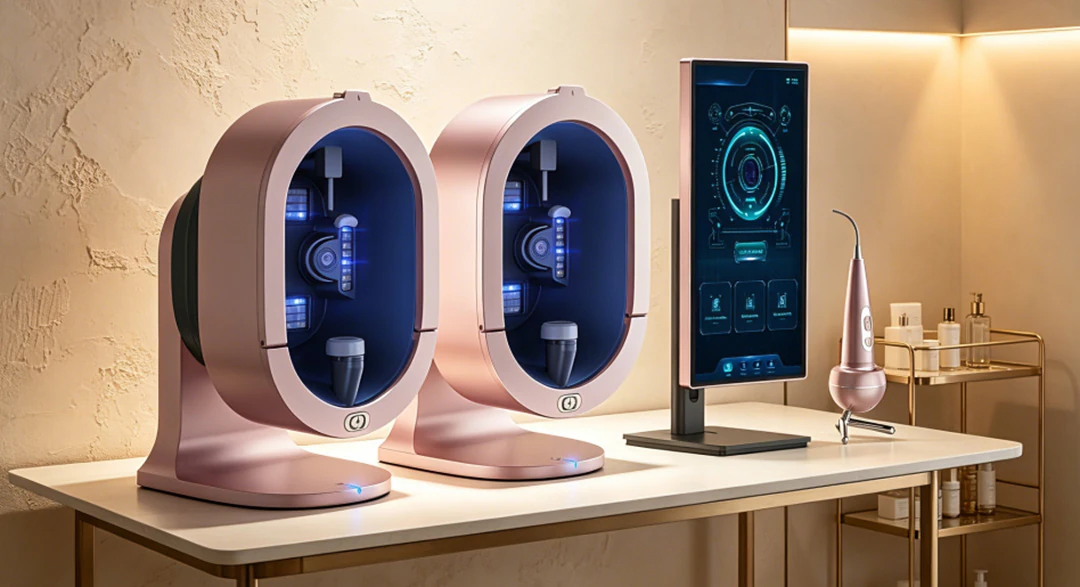
There is a significant difference between traditional manual consultations and artificial intelligence (AI)-assisted analysis. The table below compares these two approaches, clearly demonstrating the value provided by AI analysis.
| Comparison Aspect | Traditional Manual Diagnosis | AI Multi-Spectral Scanner |
| Accuracy & Depth | Surface-level assessment only. Heavily dependent on the therapist’s experience. | Quantifies more than 15 skin health indicators. Detects deep dermal concerns with consistent precision. |
| Client Trust & Engagement | Verbal explanation is subjective. Clients may remain sceptical about the need for treatment. | Visual, data-driven reports. Before-and-after comparisons build high trust and transparent communication. |
| Consultation Efficiency | 15–25 minutes. Requires detailed note-taking and manual interpretation. | 3–8 minutes. Automatic report generation with clear, graphical explanations. |
| Upselling Conversion Rate | Moderate. Persuasion depends on the individual therapist’s sales skills. | Significantly higher. Clinical evidence and objective scoring naturally reduce client resistance to premium treatment plans. |
When clients can clearly see their deep UV spots or collagen loss on the screen, the focus of the conversation shifts from “whether” they need treatment to “when” they should start treatment. That simple change in how clients view treatment recommendations often leads to much better conversion rates.
2. Financial Impact: Direct & Indirect ROI of a Professional Skin Analyzer Machine
To decide whether a professional skin analyzer machine is a sound investment, you need to examine both the revenue it generates directly and the value it unlocks indirectly. An AI skin image analyzer creates multiple income streams that, when combined, often lead to a surprisingly short payback period.
Direct Revenue Streams
- Standalone Analysis Fees: Many salons charge a separate fee for the comprehensive digital report, which can be redeemed against future treatments or products. A typical fee ranges from $25 to $50 per session. Even with just four paid analyses a day, this can contribute between $2,000 and $4,000 in monthly revenue before any product or treatment sales are made.
- Elevated Treatment Conversion (Up-Selling): This is the most powerful direct driver. An objective, colour-coded report demonstrably reduces the emotional friction in high-ticket sales. When the software grades a client’s pigmentation at 72 out of 100 and shows a predictive simulation of the concern worsening, recommending a corresponding laser treatment or a course of medical-grade chemical peels becomes a logical, clinical step rather than a sales pitch. This consistently raises the average transaction value.
Indirect Revenue and Value Creation
- Skincare Retail Boost: AI systems often come with software that maps analysed skin conditions directly to the professional skincare products you stock. This “face-to-formula” recommendation acts as a highly effective, guilt-free retail engine, turning the consultation area into a point of sale. A post-analysis skincare bundle can add $80 to $200 to a client’s ticket.
- Client Retention Through Visual Progress: A skin analysis machine is one of your best allies for keeping long-term clients. Saving treatment progression images creates a digital “trust diary.” Showing a client their before-and-after images—documenting reduced wrinkles or faded UV spots under identical lighting conditions—provides clear, irrefutable proof of your service’s efficacy. This significantly reduces churn rates and encourages powerful word-of-mouth referrals.
A Simple Monthly ROI Estimation Model
Let’s consider a conservative scenario for a salon with moderate client traffic. This model excludes intangible brand value and focuses purely on operational cash flow.
1. Monthly Lease/Depreciation Cost of Device: ~$400
2. Direct Analysis Fee Revenue: 3 paid scans/day x $30 x 25 working days = +$2,250
3. Incremental Treatment Upsell Margin: 2 clients/day upgrade to a higher-tier treatment because of report evidence, yielding an extra $40 profit per client. 2 x $40 x 25 days = +$2,000
4. Incremental Product Sales Profit: Sale of targeted serums and sunscreens post-analysis: 2 sales/day x $15 profit x 25 days = +$750
5. Total Estimated Monthly Net Return: ($2,250 + $2,000 + $750) -$400 = $4,600
In this realistic model, the device not only covers its own costs but also generates a substantial net positive return, fully recouping the initial investment within a matter of months.
3. Product Spotlight: HOMI HM-K33 AI Skin Tester
Within the landscape of diagnostic tools, the HM-K33 AI Intelligent Skin Tester, developed by HOMI, offers a practical example of how this technology can fit into a daily salon workflow. For many salons, the analyzer becomes the starting point of every consultation. Instead of relying on experience alone, therapists can explain skin conditions with measurable data, making treatment recommendations much easier for clients to accept.
The HM-K33 features an 8-spectrum imaging system, which goes beyond standard triple-light analysis to provide a more nuanced view of both the epidermal surface and deeper dermal tissues. Its mechanical design enables a 180-degree automated scan, capturing a three-dimensional perspective of the face—front, left, and right profiles simultaneously—without any manual repositioning. The integrated software objectively scores 17 core skin health indicators, covering moisture level, oil balance, sensitivity, wrinkles, pore size, deep pigmentation, and acne grade. This quantification standardises the consultation, ensuring every client receives a thorough and consistent assessment.
Beyond standalone use, the real strength of the HM-K33 becomes clear when it is integrated into a broader treatment protocol. It serves as the logical first step in a closed-loop aesthetic system. For instance, after the analyzer precisely maps the depth and area of dermal pigmentation or atrophic acne scarring, the data supports a directly bookable treatment with a Fractional CO2 Laser Resurfacing device for facial rejuvenation. Equally, when evaluating skin types and hair follicle condition before hair removal, the analysis provides valuable supporting data for the use of a diode laser hair removal machine. In practice, the scanner helps salons move naturally from consultation to treatment planning instead of relying only on verbal recommendations.
4. Sourcing Smart: How to Partner with a Skin Analyzer Machine Factory
For salon owners, the path to maximising ROI often starts not with the sale to the client, but with the purchase of the equipment. The single most effective way to shorten your payback period is to source directly from a reputable skin analyzer machine factory. By bypassing distributors and retail middlemen, you can reduce your initial capital outlay by a meaningful margin, immediately improving your net return.
Partnering directly with a manufacturer like HOMI offers three critical advantages:
- Capital Efficiency: A direct-from-factory purchasing model delivers a more competitive ex-works price. This lower upfront investment means your break-even point is reached much faster—a crucial factor for any small business.
- OEM/ODM Customisation: A factory partnership allows you to build your own brand. You can typically request custom logo branding on the hardware and tailor the software’s user interface language and report design to match your salon’s visual identity. This is an invaluable asset for salons developing a chain or a premium brand experience.
- Reliable After-Sales Support: An original equipment manufacturer offers more than just a warranty. An established skin analyzer machine factory like HOMI, which operates as both a manufacturing and R&D base, provides direct access to factory-trained engineers and authentic replacement parts. They also offer comprehensive pre-shipment inspection and remote training support, ensuring that the technology integrates into your business seamlessly and starts generating profit from day one—rather than becoming an underutilised asset.
5. FAQ
Q1: How long does a full analysis take with a device like the HM-K33?
The entire process—from the client sitting down to the generation of a full cloud-based report—is typically completed within a few minutes. The automated 180-degree scanning and AI analysis are extremely rapid, making it a perfect, high-engagement step during the reception or initial consultation flow.
Q2: Do beauty therapists need specialised medical training to operate a professional skin analyzer machine?
No, an extensive medical background is not required. A quality professional skin analyzer machine is designed for intuitive use. The HM-K33, for example, features a streamlined interface. The device automatically interprets the diagnostic data and even suggests suitable skincare ingredients or treatment recommendations, allowing a typical esthetician to operate it proficiently after brief, straightforward training.
Q3: What is a realistic payback period for a high-quality skin analysis machine?
Based on the financial model discussed, and depending on a salon’s client traffic and service pricing, the payback period for a well-sourced skin analysis machine is generally between 2 and 4 months. This period accounts for revenue from standalone diagnostic fees, the high-margin skincare products sold directly after analysis, and the conversion of clients to more advanced, higher-value treatment plans.
Conclusion
For salons looking to improve consultation quality and increase treatment conversion, an AI skin analyzer can quickly become one of the most valuable pieces of equipment in daily operation. Choosing the right supplier and integrating the device into your consultation process are what ultimately determine how quickly the investment pays for itself. It elevates a salon’s professionalism, builds client trust through objective evidence, and generates additional revenue streams—from scan fees and product sales to higher treatment plan acceptance rates. The key to accelerating this return lies in an informed purchasing decision. By forming a partnership with a dedicated, research-driven skin analyzer machine factory, salons and medspas can significantly lower the barrier to entry and secure a low-risk, high-reward asset that positions them firmly for the future of aesthetic beauty.